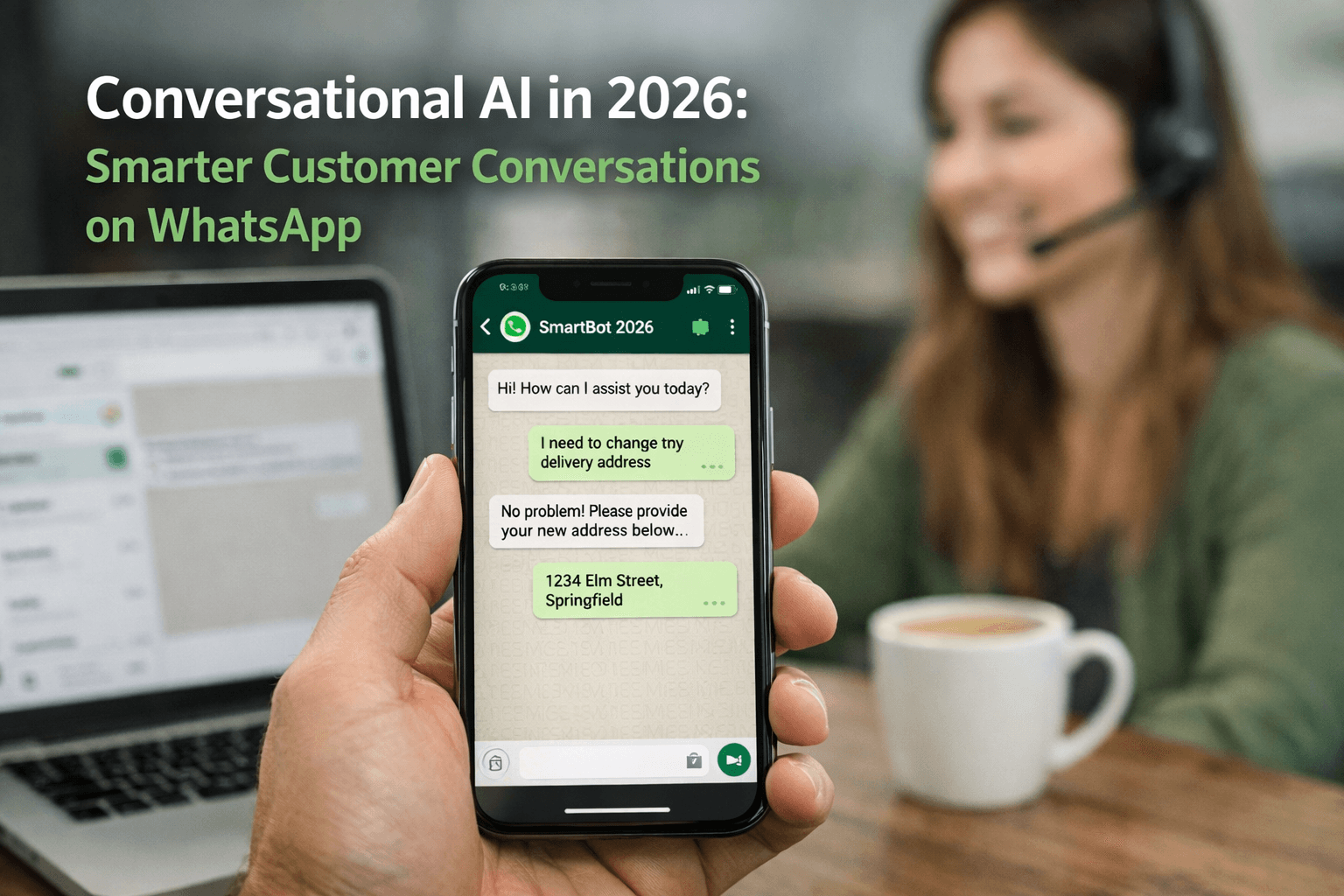
Customer expectations are higher than ever. People want instant replies, personalized answers, and smooth support — all in the same place where they already chat with friends and family.
That’s why Conversational AI is becoming a key part of modern business communication, especially on WhatsApp.
In this blog, we’ll break down what Conversational AI means, how it works, and how businesses can use it to create faster, smarter, and more human-like interactions.
What Is Conversational AI?
Conversational AI is technology that allows computers to understand and respond to human language naturally.
It powers:
AI-powered chatbots
Intelligent virtual agents
Smart voice assistants
Unlike basic bots that only send pre-written replies, Conversational AI understands intent, context, and conversation flow. It can handle follow-up questions, remember previous interactions, and provide relevant answers in real time.
In simple terms, it feels less like talking to a machine — and more like chatting with a helpful assistant.
How Conversational AI Works
Conversational AI combines several technologies:
Natural Language Processing (NLP)
Helps the system understand what the customer is saying and what they mean.
Machine Learning (ML)
Allows the AI to learn from past conversations and improve over time.
Context Memory
Keeps track of previous messages to deliver more personalized responses.
System Integrations
Connects with CRMs, payment gateways, order management systems, and databases to give real-time information.
When connected to the WhatsApp Business API, this technology can manage thousands of conversations at once — without delays.
Why Businesses Are Adopting Conversational AI
1. 24/7 Instant Support
Customers don’t want to wait. AI ensures replies are instant — even outside office hours.
2. Lower Costs, Higher Efficiency
AI handles repetitive questions, allowing human teams to focus on complex issues and strategic tasks.
3. Better Lead Management
Businesses can use WhatsApp lead automation for real estate agents to instantly capture inquiries, qualify prospects, and assign hot leads to the sales team.
4. Higher Sales and Engagement
Brands can Boost E-commerce Sales with WhatsApp by guiding customers from product discovery to payment — directly inside chat.
5. Smarter Campaign Tracking
With click tracking for WhatsApp marketing, companies can measure which campaigns drive the most engagement and optimize future communication.
Conversational AI Inside WhatsApp
WhatsApp has become one of the most powerful communication channels for businesses worldwide. When combined with AI, it turns into a complete WhatsApp Communication Platform.
Here’s what companies can automate:
FAQs and support queries
Product recommendations
Order tracking
Appointment scheduling
Payment confirmations
Feedback collection
Instead of switching between tools, teams can manage everything through a multi-channel live chat inbox that centralizes conversations from WhatsApp and other platforms.
Industry Use Cases
Conversational AI is not limited to one sector. It works across industries:
E-commerce
Product suggestions
Cart recovery reminders
Order updates
Personalized offers
Real Estate
Automated property recommendations
Budget and location qualification
Real estate automation with WhatsApp to pre-screen buyers before agent calls
Healthcare
Appointment booking
Automated reminders to patients
Basic symptom guidance
Education
Course inquiries
Enrollment assistance
Automated class reminders
Travel & Tourism
Booking confirmations
Itinerary updates
Automated travel booking confirmations
Each industry benefits from faster responses and reduced manual effort.
From Chatbots to Smart AI Agents
Modern AI systems are no longer simple rule-based bots. Today’s Smart AI chatbot for business can:
Understand customer intent
Handle multi-step conversations
Pull real-time data
Escalate complex issues to human agents
This creates a balanced system where automation handles speed, and humans handle empathy and complex decisions.
The Power of Omnichannel Communication
Customers don’t use just one platform. They move between WhatsApp, websites, social media, and email.
An omnichannel messaging platform ensures consistent communication across all touchpoints. With AI managing responses, businesses can provide unified, personalized support everywhere — without increasing team size.
The Future of Conversational AI
By 2030, most customer interactions are expected to be AI-driven.
The shift is already happening:
From reactive bots to proactive AI agents
From simple replies to personalized recommendations
From manual follow-ups to automated drip campaigns with fallback messaging
Businesses that adopt Conversational AI now will not only reduce costs — they’ll also build stronger, more responsive customer relationships.
Final Thoughts
Conversational AI is transforming how businesses communicate.
It delivers:
Faster replies
Personalized experiences
Better lead conversion
Scalable support
Whether you’re in e-commerce, healthcare, real estate, education, or travel, integrating AI with WhatsApp can significantly improve engagement and efficiency.
The future of customer communication is simple, smart, and automated — and it’s already here.