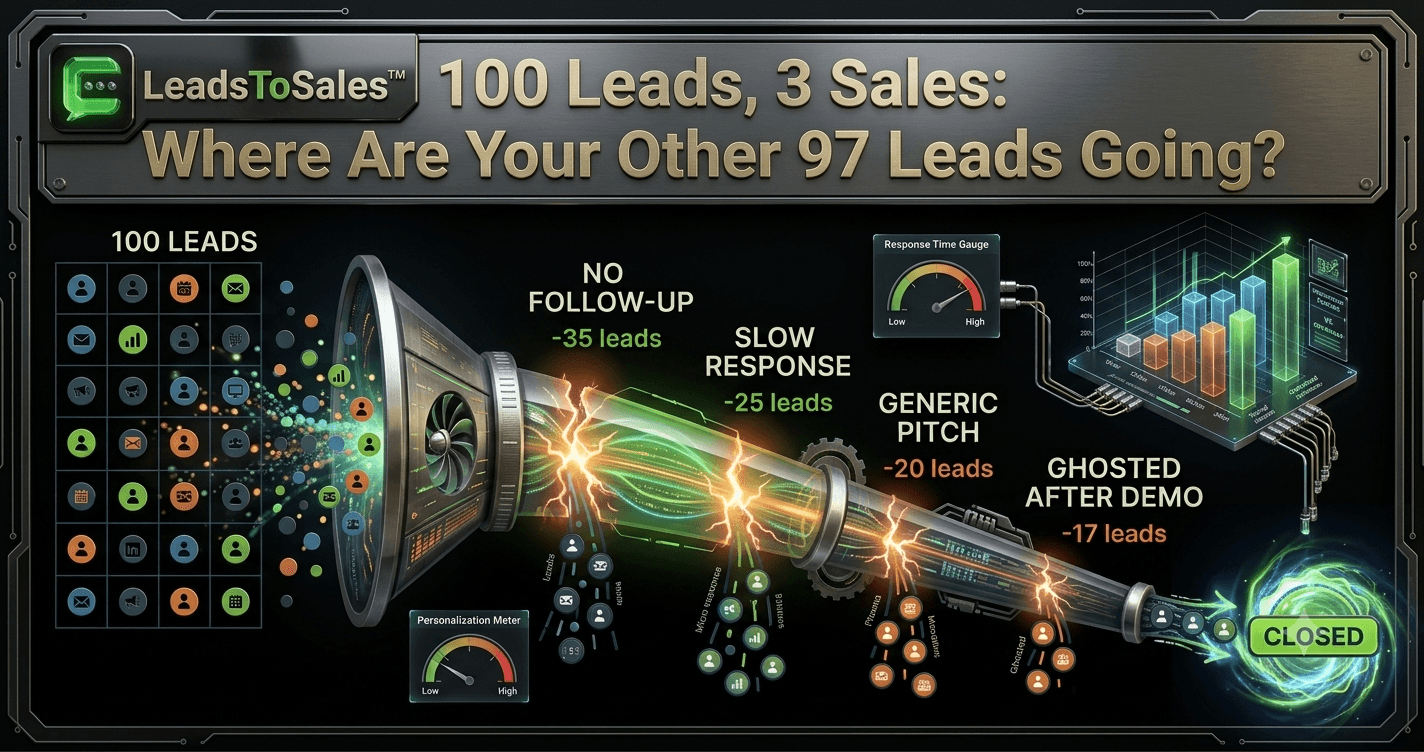
Getting leads on WhatsApp is easy.
Making sure every lead reaches the right salesperson at the right time is much harder.
When several salespeople use the same WhatsApp number, businesses often rely on manual forwarding, WhatsApp groups, spreadsheets, or simply asking, “Who is handling this lead?”
That creates a familiar set of problems:
Two salespeople contact the same customer.
Nobody takes ownership of a new enquiry.
Leads are assigned to someone who is unavailable.
Regional or product-specific leads reach the wrong salesperson.
Managers have no clear view of who owns each conversation.
A salesperson leaves, and their leads become difficult to track.
High-intent leads wait while the team decides who should respond.
This is where WhatsApp lead routing becomes useful.
Instead of asking a manager or salesperson to decide who handles every new enquiry, businesses can define routing rules that automatically assign each lead to the appropriate person or team.
For businesses using WhatsApp for sales, customer acquisition, and support, this turns lead assignment from a manual task into a repeatable workflow.
What Is WhatsApp Lead Routing?
WhatsApp lead routing is the process of automatically assigning incoming WhatsApp leads to the appropriate salesperson based on predefined rules.
Those rules can consider factors such as:
Location
Product or service
Lead source
Language
Budget
Customer type
Salesperson availability
Working hours
Existing account ownership
Lead priority
Sales team capacity
For example, imagine a real estate company receives a WhatsApp enquiry:
“I am looking for a 3 BHK apartment in Noida with a budget of ₹1.2 crore.”
Instead of sending the enquiry into a general WhatsApp group, an automated workflow could identify:
Location: Noida
Property type: 3 BHK
Budget: ₹1.2 crore
Lead type: Buyer
Language: English
The system can then assign the conversation to the appropriate Noida sales team or salesperson.
The salesperson receives the lead together with the information already collected.
That means the customer does not have to repeat the same information to multiple people.
Why Manual WhatsApp Lead Assignment Becomes a Problem
Manual assignment can work when a business receives only a few enquiries every day.
As lead volume increases, however, the process becomes harder to control.
A typical manual process might look like this:
A customer sends a WhatsApp message.
Someone notices the message.
The conversation is forwarded to a salesperson.
The salesperson checks whether they should handle it.
If they are unavailable, the lead is forwarded again.
Someone else eventually responds.
The manager tries to remember who owns the conversation.
Every additional step creates another opportunity for delay or confusion.
A better process is:
New lead → Identify lead attributes → Apply routing rules → Assign salesperson → Notify salesperson → Start follow-up
The assignment can happen automatically instead of waiting for a manager to intervene.
Modern lead-routing systems commonly use models such as round-robin, territory, availability, skill, and source-based routing.
How Does WhatsApp Lead Routing Work?
A practical WhatsApp lead-routing workflow usually has five stages.
1. Capture the Lead
The customer starts a WhatsApp conversation.
The lead might come from:
A website
Google Ads
Facebook Ads
Instagram
A landing page
A QR code
A WhatsApp campaign
A referral
An existing customer
The first requirement is to capture the conversation and its source.
2. Collect Basic Information
Before assigning the lead, the system can ask a few relevant questions.
For a real estate business:
Which location are you interested in?
What type of property are you looking for?
What is your budget?
When are you planning to purchase?
For a SaaS company:
Which product are you interested in?
How many users do you have?
What is your company size?
Would you like to book a demo?
For a travel company:
Where are you travelling?
What are your travel dates?
How many people are travelling?
What is your approximate budget?
The goal is not to create a long questionnaire.
The goal is to collect enough information to make a useful routing decision.
3. Apply Routing Rules
The system evaluates the information collected from the conversation.
For example:
IF location = Delhi NCR
THEN assign to Delhi sales team
IF product = Enterprise SaaS
THEN assign to enterprise sales team
IF language = Hindi
THEN assign to Hindi-speaking sales pool
IF salesperson = unavailable
THEN skip that salesperson
This is where automated WhatsApp lead assignment becomes significantly more useful than simply placing every conversation into one shared inbox.
4. Assign an Owner
Every lead should have a clear owner.
The assigned salesperson can receive:
Customer name
Phone number
WhatsApp conversation
Lead source
Qualification information
Product or service requested
Lead priority
Previous interactions
Required next action
The salesperson should not have to start from zero.
5. Track What Happens Next
Routing should not end when a salesperson is assigned.
The system should continue tracking:
Assignment time
First response
Follow-up activity
Lead status
Reassignment
Appointment
Conversion
Lost reason
This creates accountability across the sales process.
7 WhatsApp Lead Routing Rules Businesses Can Use
There is no single routing strategy that works for every business.
Most teams combine several rules.
1. Round-Robin Lead Assignment
Round-robin routing distributes leads sequentially among a group of salespeople.
For example:
Lead 1 → Salesperson A
Lead 2 → Salesperson B
Lead 3 → Salesperson C
Lead 4 → Salesperson A
This works well when salespeople have similar responsibilities and territories.
It is simple, predictable, and easy to manage.
However, round-robin should not blindly assign leads to someone who is on leave, outside working hours, or handling a completely different type of customer.
That is why availability and skill rules can be added on top of the rotation.
2. Location-Based Routing
Location-based routing assigns leads according to geography.
For example:
Delhi → Delhi sales team
Mumbai → Mumbai sales team
Bengaluru → Bengaluru sales team
Dubai → UAE sales team
This can be particularly useful for businesses with regional sales teams.
For Indian businesses, routing can also use cities, states, territories, or other location information collected during the conversation.
3. Product-Based Routing
Different products often require different sales expertise.
For example:
Basic plan → SMB sales
Enterprise plan → Enterprise sales
Technical product → Technical sales
Premium property → Luxury property team
The WhatsApp conversation can identify the product or service before assigning the lead.
This prevents salespeople from receiving enquiries outside their area of expertise.
4. Lead-Quality Routing
Not every lead needs the same level of sales attention.
A business can create routing rules based on lead signals such as:
Budget
Purchase timeline
Company size
Product interest
Customer type
Previous interactions
For example:
A high-intent enterprise lead could go directly to a senior sales representative.
A low-intent enquiry could enter a nurturing workflow first.
The important point is that lead quality should determine workflow priority, not just salesperson assignment.
5. Language-Based Routing
Language can be an important part of the customer experience.
A business serving customers across India, for example, may have salespeople who handle Hindi, English, Tamil, Telugu, Marathi, Bengali, or other languages.
The customer can select a preferred language in the WhatsApp conversation, after which the lead can be routed to the appropriate team.
This can make the conversation more natural without requiring the customer to explain their preference to multiple employees.
6. Availability-Based Routing
A common mistake is assigning leads based only on the salesperson's role.
What happens if that salesperson is:
On leave?
Offline?
Already handling too many conversations?
Outside their working hours?
Temporarily unavailable?
A good routing workflow should check availability before assigning the lead.
If the preferred salesperson is unavailable, the system can route the conversation to another qualified salesperson.
Availability-based routing is especially important for teams working across shifts or time zones.
7. Campaign or Source-Based Routing
You can also route leads based on where they came from.
For example:
Google Ads → Performance sales team
Facebook campaign → Social media sales team
Real estate portal → Property sales team
Referral → Senior sales team
This is useful when different lead sources have different processes or sales teams.
What Happens When a Salesperson Does Not Respond?
Assigning a lead is only half the problem.
The next question is:
What happens if the salesperson does nothing?
Without a backup process, the lead can remain assigned but untouched.
A better workflow can include a response-time rule.
For example:
New lead
↓
Assign salesperson
↓
Notify salesperson
↓
Wait for response
↓
No response within defined SLA
↓
Send reminder
↓
Still no response
↓
Reassign to another available salesperson
This creates a safety net.
The exact response-time target should depend on the business, lead source, operating hours, and sales process.
The important principle is that assignment should not equal completion.
A lead is not really handled until someone has responded or the workflow has moved it to another appropriate stage.
WhatsApp Lead Routing for Real Estate
Real estate is one of the clearest examples of where lead routing can solve an operational problem.
A property business may receive enquiries from:
99acres
Magicbricks
Housing portals
Google Ads
Facebook Ads
Instagram
Property websites
QR codes
Offline campaigns
A customer might ask:
“I need a 2 BHK in Gurgaon under ₹90 lakh.”
Instead of sending the enquiry to a generic sales group, the workflow can identify:
City: Gurgaon
Property: 2 BHK
Budget: ₹90 lakh
Customer type: Buyer
The lead can then be assigned to the appropriate salesperson.
For larger property teams, additional rules can include:
Project
Micro-market
Budget
Property configuration
Language
Lead source
Agent availability
Existing customer relationship
Current real-estate WhatsApp workflows increasingly combine lead capture, qualification, routing, site-visit scheduling, and follow-up rather than treating WhatsApp as only a messaging channel.
This makes WhatsApp lead automation for real estate agents particularly useful when multiple agents are handling enquiries from different projects or locations.
A Practical Real Estate Routing Example
Imagine a real estate company has three salespeople:
Agent A handles Gurgaon.
Agent B handles Noida.
Agent C handles Delhi.
A customer sends:
“Hi, I want a 3 BHK in Noida.”
The WhatsApp workflow can:
Identify the customer's requirement.
Ask for the approximate budget.
Confirm the preferred location.
Identify Noida as the territory.
Check which Noida salesperson is available.
Assign the conversation.
Notify the salesperson.
Send the customer an acknowledgement.
Start the follow-up workflow.
Track whether the salesperson responds.
The salesperson receives the conversation with context rather than just a phone number.
That makes the handoff much cleaner.
What Information Should You Collect Before Routing?
You do not need to ask every customer 20 questions.
Collect only information that actually affects the routing decision.
Depending on the business, useful fields may include:
Customer Information
Name
Phone number
Preferred language
Location
Requirement Information
Product
Service
Budget
Quantity
Purchase timeline
Lead Information
Campaign
Source
Landing page
Referral
Existing customer status
Sales Information
Assigned salesperson
Team
Lead priority
Follow-up date
Lead status
The fewer unnecessary questions you ask, the easier the WhatsApp experience becomes.
WhatsApp Lead Routing With AI
AI can make routing more flexible because customers do not always answer questions in a fixed format.
A customer might write:
“Looking for a 3bhk around 1 crore near Noida, preferably ready to move.”
An AI-powered workflow can extract useful information such as:
Property type: 3 BHK
Budget: Around ₹1 crore
Location: Noida
Preference: Ready to move
That information can then feed into routing rules.
AI can also help summarize the conversation before handing it to a salesperson.
Instead of the salesperson reading 20 messages, they might receive a summary such as:
Lead: Rahul
Requirement: 3 BHK
Location: Noida
Budget: ₹1 crore
Timeline: Within 3 months
Status: High intent
The salesperson can then start the conversation with context.
AI should support the routing process rather than replace the business rules completely.
The business still needs to decide which leads go to which teams and what happens when a rule cannot find a suitable salesperson.
How to Build a WhatsApp Lead Routing Workflow
If you are setting up WhatsApp lead routing for your business, start with a simple process.
Step 1: Identify Your Sales Teams
List the teams and salespeople who will receive WhatsApp leads.
For example:
North India sales
South India sales
Enterprise sales
SMB sales
Existing customer team
Step 2: Define Your Routing Rules
Ask:
What information determines who should handle a lead?
It could be:
Location
Product
Customer type
Language
Budget
Lead source
Start with the rules that actually matter.
Step 3: Create Your Fallback
Every routing system needs a fallback.
What happens when:
No salesperson matches?
Everyone is offline?
The lead's location is unknown?
The customer gives incomplete information?
You could route the conversation to:
A general sales team
A sales manager
An available representative
A qualification workflow
Never allow a lead to simply disappear because it did not match a rule.
Step 4: Add Availability Rules
Make sure the workflow knows who is available.
A salesperson who is on leave should not continue receiving new leads.
Step 5: Add Response-Time Rules
Track whether the assigned salesperson actually responds.
If not, trigger a reminder or reassignment.
Step 6: Connect the Lead to Your CRM
The WhatsApp conversation should not exist separately from the rest of your sales process.
Important information should flow into your CRM or lead-management system.
That gives managers visibility into:
New leads
Assigned leads
Uncontacted leads
Active conversations
Follow-ups
Conversions
Step 7: Monitor the Routing
After launching the workflow, look for problems.
Ask:
Are some salespeople receiving too many leads?
Are certain leads being assigned incorrectly?
Are leads being reassigned too often?
Are high-value leads reaching the right team?
Are response times improving?
Routing rules should be adjusted based on real operational data.
How Chati Can Support WhatsApp Lead Routing
For businesses using WhatsApp as a sales channel, routing works best when it is part of a larger automation workflow.
Chati can help businesses bring WhatsApp conversations, automation, customer data, and sales workflows into a more structured process.
A typical workflow can look like:
Lead Source → WhatsApp → Automated Conversation → Qualification → Lead Assignment → Salesperson → Follow-Up → Conversion
Instead of making salespeople manually monitor every new WhatsApp conversation, automation can handle repetitive steps and pass the right conversations to the team.
Chati also supports broader WhatsApp automation use cases such as campaign management, customer segmentation, analytics, and integrations across business systems.
The goal is not to automate every customer interaction.
The goal is to automate the repetitive parts while giving salespeople the conversations that need human attention.
Metrics to Track After Implementing Lead Routing
Once routing is automated, measure whether it is actually improving your sales process.
Lead Assignment Time
How long does it take for a new lead to receive an owner?
First Response Time
How long does the customer wait before a salesperson responds?
Unassigned Lead Rate
How many leads remain without an owner?
Reassignment Rate
How often do leads need to be moved to another salesperson?
Response SLA
How many assigned leads receive a response within your target timeframe?
Conversion by Salesperson
Which salespeople are converting their assigned leads?
Conversion by Source
Which campaigns and channels generate the most valuable conversations?
Conversion by Routing Rule
Are location-based, product-based, or other routing rules producing the expected results?
These metrics help turn lead routing from a technical feature into a measurable sales process.
Common WhatsApp Lead Routing Mistakes
Mistake 1: Using Only Round-Robin
Round-robin is simple, but not every salesperson is equally suited to every lead.
Use additional rules when location, product, language, or expertise matters.
Mistake 2: Ignoring Availability
Do not assign leads to people who are unavailable.
Add working-hour and availability logic where appropriate.
Mistake 3: Asking Too Many Questions
Qualification should help routing, not create friction.
Only ask questions that influence the next step.
Mistake 4: No Fallback Route
There will always be leads that do not fit your rules.
Create a default team or manager route.
Mistake 5: No Reassignment Logic
If the assigned salesperson does not respond, the system should have a next step.
Mistake 6: Losing Conversation Context
The salesperson should receive the relevant conversation history and lead information.
Otherwise, customers may have to repeat themselves.
Mistake 7: Measuring Only Lead Volume
Sending 1,000 leads to a sales team does not mean the routing system is working.
Look at response time, ownership, follow-up, and conversion.
Which Businesses Can Use WhatsApp Lead Routing?
WhatsApp lead routing is useful anywhere multiple people handle inbound customer conversations.
Real Estate
Route buyers based on:
Project
Location
Budget
Property type
Agent availability
SaaS
Route prospects based on:
Product
Company size
Plan
Industry
Enterprise requirements
Education
Route enquiries based on:
Course
Campus
Location
Intake
Language
Travel
Route customers based on:
Destination
Travel dates
Package
Budget
Region
Healthcare
Route appointment and service enquiries to the appropriate department or coordinator, while keeping sensitive workflows appropriately controlled.
E-commerce
Route complex sales or support conversations based on:
Product
Order type
Customer status
Issue category
The exact rules will vary by business, but the underlying problem is the same:
Who should handle this conversation?
WhatsApp Lead Routing vs Manual Assignment
Manual assignment asks your team to repeatedly answer:
“Who should take this lead?”
Automated routing answers that question using predefined business rules.
The difference becomes especially important as lead volume grows.
With manual assignment, managers spend time distributing conversations.
With automated routing, the system can assign conversations as they arrive.
With manual assignment, availability may be checked informally.
With automated routing, availability can become part of the rule.
With manual assignment, reassignment depends on someone noticing a problem.
With automated routing, a response-time rule can trigger the next action.
The objective is not simply to eliminate manual work.
It is to make lead ownership consistent, visible, and measurable.
Frequently Asked Questions
What is WhatsApp lead routing?
WhatsApp lead routing is the process of automatically assigning incoming WhatsApp conversations to the appropriate salesperson or team based on predefined rules such as location, product, language, lead source, availability, or customer type.
How does WhatsApp lead assignment work?
A routing workflow collects information about a new lead, evaluates predefined rules, identifies the appropriate salesperson or team, assigns the conversation, and notifies the person responsible for the next step.
Can WhatsApp leads be assigned automatically?
Yes. Businesses can use WhatsApp automation and connected sales systems to automatically assign conversations based on rules such as round-robin distribution, location, product, language, availability, or lead source.
What is round-robin WhatsApp lead routing?
Round-robin routing distributes incoming leads sequentially among a defined group of salespeople. It can help distribute leads evenly, particularly when salespeople have similar responsibilities.
Can WhatsApp leads be routed based on location?
Yes. A business can use location information collected from the customer to route leads to a salesperson or team responsible for a particular city, region, territory, or market.
Can WhatsApp leads be assigned based on salesperson availability?
Yes. Availability can be included in routing logic so that new leads are assigned to available salespeople instead of people who are offline, on leave, or outside their working hours.
What happens if a salesperson does not respond?
A business can create an SLA-based workflow that sends a reminder after a defined period and potentially reassigns the lead to another available salesperson.
Is WhatsApp lead routing useful for real estate?
Yes. Real estate teams can route property enquiries based on project, location, budget, property type, language, lead source, and salesperson availability.
Can AI help with WhatsApp lead routing?
Yes. AI can extract information from natural-language conversations, summarize conversations, identify useful lead attributes, and help trigger routing rules. Businesses should still define the underlying assignment and fallback rules.
Does WhatsApp lead routing replace a CRM?
Not necessarily. Routing is one part of lead management. Connecting WhatsApp with a CRM can provide broader visibility into lead ownership, follow-ups, pipeline stages, and conversions.
Final Thoughts
Generating a WhatsApp lead is only the beginning.
The real operational question is:
Who should handle it?
If that decision depends on a manager noticing a message, a salesperson checking a group, or someone manually forwarding a conversation, the process becomes difficult to scale.
WhatsApp lead routing creates a clearer workflow:
Capture → Understand → Route → Assign → Respond → Follow Up → Convert
For a small team, that might begin with simple round-robin assignment.
For a larger sales operation, it can evolve into rules based on location, product, language, lead quality, availability, campaign source, and response time.
The most important principle is simple:
Every new WhatsApp lead should have a clear owner and a clear next step.
When lead ownership is automated, salespeople spend less time figuring out who should handle a conversation and more time actually having the conversation.