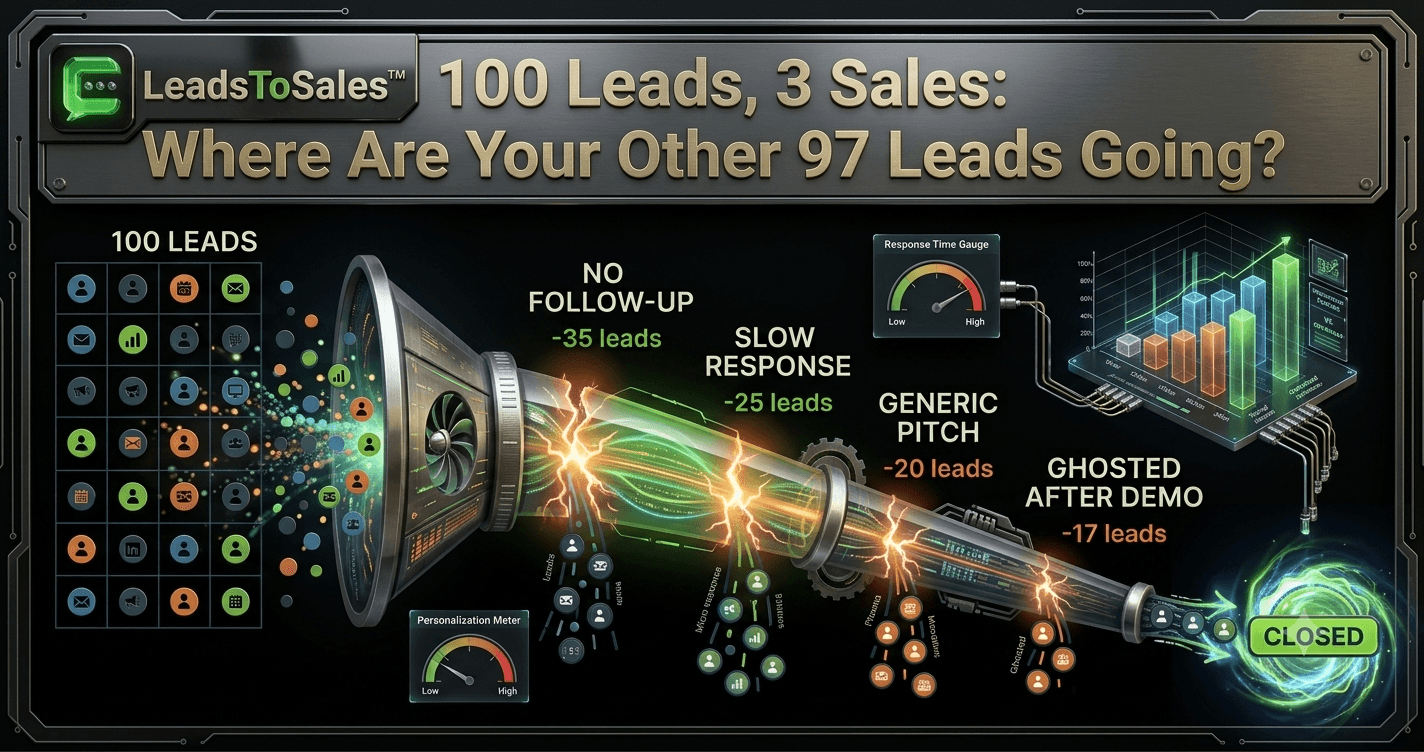
Getting 100 leads sounds like a marketing win.
But what if only 3 of those leads become customers?
The problem may not be your marketing.
The real problem could be what happens after a lead enters your business.
Leads can be missed, contacted too late, forgotten after the first conversation, poorly qualified, or lost because nobody follows up at the right time.
This is where WhatsApp can become more than a messaging app. With the right WhatsApp Marketing Automation Platform, businesses can respond faster, qualify leads, automate follow-ups, and give sales teams a better way to manage conversations.
So, where are those other 97 leads going?
The Lead Problem Starts After Lead Generation
Businesses spend heavily on ads, social media, SEO, landing pages, and campaigns to generate leads.
But generating a lead is only the beginning.
Consider this simple example:
100 people show interest
70 receive a response
40 are properly qualified
20 receive consistent follow-ups
8 book a meeting or appointment
3 become customers
The business may look at the final number and say:
“We need more leads.”
But that may not be true.
The business may already have enough leads. It may simply be losing leads during the sales process.
1. Leads Are Not Contacted Quickly Enough
A potential customer usually has a reason for contacting a business right now.
They may be comparing products, checking prices, looking for a service, or ready to make a purchase.
If they submit a form in the morning and receive a response in the evening, they may already be talking to another company.
WhatsApp can help businesses send an immediate response after a lead enters the system.
Instead of waiting for a salesperson to notice a new lead, an automated message can acknowledge the inquiry and start the conversation.
For example:
“Hi Rahul, thanks for contacting us. What service are you interested in?”
That first response keeps the conversation moving while the sales team prepares to take over.
2. Sales Teams Forget to Follow Up
Not every customer buys after the first conversation.
A lead may say:
“I'll think about it.”
“I'll discuss it with my partner.”
“Contact me next week.”
“I need more information.”
“I'll get back to you.”
And then the conversation gets forgotten.
This is one of the biggest gaps in lead management.
A proper follow-up process can use automated drip campaigns with fallback messaging to keep leads engaged without requiring salespeople to remember every follow-up manually.
For example:
Day 1: Send product information.
Day 3: Ask if the customer has questions.
Day 7: Share a relevant case study or offer.
Day 14: Send a final follow-up.
The goal is not to spam customers.
The goal is to make sure genuinely interested leads do not disappear simply because someone forgot to follow up.
3. Businesses Do Not Know Which Leads Are Worth Calling
Not every lead has the same value.
One person may be casually browsing.
Another may have a clear requirement, budget, and buying timeline.
If salespeople treat both leads the same way, valuable time is wasted.
WhatsApp can be used to collect basic information before a salesperson gets involved.
For example:
What are you looking for?
What is your approximate budget?
When are you planning to buy?
Would you like a call from our team?
These questions can help businesses identify high-intent prospects.
This is where a Smart AI chatbot for business can help handle simple qualification conversations before passing the lead to a human salesperson.
4. Leads Are Spread Across Different Channels
Modern businesses rarely receive leads from just one source.
A company may receive customers through:
Website forms
Facebook
Instagram
Google Ads
WhatsApp
Phone calls
Email
Landing pages
When conversations are scattered across different systems, sales teams can easily miss messages.
An omnichannel live chat inbox can bring customer conversations into one workspace.
A sales representative can see conversations, respond to customers, and manage interactions without constantly switching between platforms.
For businesses handling large volumes of conversations, whatsapp instagram facebook unified inbox workflows can make lead management much easier.
5. Businesses Cannot See Which Campaigns Generate Real Customers
Getting clicks is not the same as getting sales.
A campaign may generate thousands of clicks but very few customers.
Another campaign may generate fewer clicks but produce high-value customers.
That is why businesses need more than basic campaign metrics.
A whatsapp click tracking tool can help businesses understand how users interact with WhatsApp links and campaigns.
With whatsapp campaign tracking, businesses can compare campaigns and identify which sources generate meaningful engagement.
The important question is not:
“How many people clicked?”
It is:
“How many people clicked, started a conversation, became qualified, and eventually purchased?”
That connects marketing activity to actual business results.
6. Customers Leave When the Experience Is Too Slow
Imagine a customer sends a WhatsApp message and receives no response.
They send another message.
Still nothing.
Eventually, they move to another business.
Customers increasingly expect quick communication.
A WhatsApp customer support automation tool can handle common questions instantly while sending more complex requests to a human agent.
For example, an automated system can answer:
Pricing questions
Business hours
Product availability
Location
Appointment availability
Order status
Basic service information
Human employees can then focus on conversations that actually require human attention.
7. Follow-Up Should Not Stop at One Channel
WhatsApp is powerful, but every customer prefers communication differently.
Some customers respond better to WhatsApp.
Others may respond to email or SMS.
For businesses with multiple communication channels, multi-channel drip campaign automation can create a more consistent follow-up experience.
For example:
Day 1: WhatsApp message
Day 3: Email
Day 5: WhatsApp follow-up
Day 8: SMS reminder
The important part is having a clear customer journey instead of sending random messages from different systems.
WhatsApp Is Not the Solution to Every Lead Problem
It is important to be realistic.
Simply sending more WhatsApp messages will not automatically increase sales.
Businesses still need:
Good lead qualification
A clear sales process
Relevant messaging
Proper lead assignment
CRM integration
Follow-up rules
Campaign tracking
Human sales support
WhatsApp works best when it becomes part of a larger lead-management system.
The Better Lead Workflow
A more effective process looks like this:
Lead Generation → Instant WhatsApp Response → Lead Qualification → Salesperson Assignment → Follow-Up → Appointment or Purchase → Customer Support
Instead of leaving the salesperson responsible for every step, automation can handle repetitive tasks.
The salesperson can then focus on the conversations most likely to generate revenue.
Example: Real Estate
Real estate is a good example because many inquiries require repeated follow-ups.
A lead clicks an advertisement and starts a WhatsApp conversation.
The system can ask:
“Which location are you interested in?”
Then:
“What is your budget?”
Then:
“Are you looking for a 2 BHK, 3 BHK, or another property?”
Based on the answers, the lead can be assigned to the right salesperson.
This makes WhatsApp Lead Automation for Real Estate Agents useful for reducing manual work and improving response times.
The same concept can be adapted for education, healthcare, travel, restaurants, e-commerce, and financial services.
The Real Cost of Losing 97 Leads
Let's say a business receives 100 leads every month.
If the average customer is worth $500, even a small improvement in conversion can have a meaningful impact.
If the business converts 3 customers today, improving the process to convert 5 or 6 customers could generate significantly more revenue without doubling the advertising budget.
That is why businesses should not always ask:
“How can we generate more leads?”
They should also ask:
“How many leads are we already losing?”
The Future of Lead Management Is Conversation-Based
Customers do not think in terms of CRM stages.
They think in terms of questions, answers, problems, prices, appointments, and decisions.
That makes conversational channels increasingly important.
A WhatsApp Communication Platform can connect automated conversations, human sales teams, customer support, and business systems into one workflow.
The goal is simple:
Capture every lead. Respond quickly. Qualify intelligently. Follow up consistently. Give salespeople the right conversations at the right time.
Final Thoughts
If 100 leads produce only 3 sales, buying more leads may not be the first solution.
Before increasing your marketing budget, look at what happens to the leads you already have.
How quickly are they contacted?
How many are properly qualified?
How many receive a second follow-up?
How many go cold because nobody responds?
How many are lost between WhatsApp, email, social media, spreadsheets, and CRM systems?
Your next 10 customers may not be hiding in another advertising campaign.
They may already be sitting inside the 97 leads you are currently losing.
The opportunity is not always to generate more leads.
Sometimes, it is to stop losing the leads you already paid for.