A customer signs up for your SaaS product.
They receive the welcome email, open your dashboard, and get stuck.
Maybe they cannot connect an integration. Maybe they don't understand a feature. Maybe an error message appears that they have never seen before.
So they do what most customers do today: they message you.
And then they wait.
Five minutes becomes thirty. Thirty becomes a few hours. By the time someone from your support team replies, the customer may have already searched for another solution—or worse, started evaluating a competitor.
This is the customer communication problem many SaaS businesses are facing.
It isn't necessarily because support teams are doing a bad job. The problem is that customer conversations have grown faster than teams can manage them manually.
That's where conversational automation can make a real difference.
The Real Problem Isn't Too Many Messages
At first, getting more customer messages sounds like a good thing.
It means people are interested. They're using your product. They're asking questions.
But as your customer base grows, the same pattern starts repeating.
Customers ask:
"How do I set this up?"
"Where can I find this feature?"
"Why isn't my integration working?"
"Can I change my plan?"
"How do I reset my password?"
"Can someone help me with this?"
Your support team answers the same questions again and again.
Meanwhile, genuinely difficult problems are sitting in the queue.
This creates a frustrating cycle:
More customers → more conversations → more repetitive questions → longer response times → frustrated customers → overloaded support teams.
Simply hiring more agents can help, but it doesn't solve the underlying problem.
You need to separate conversations that require human expertise from conversations that can be resolved immediately.
Customers Don't Need a Human for Every Question
This is one of the biggest misconceptions about customer support automation.
Automation doesn't have to mean replacing your support team.
It means allowing your team to spend their time where human judgment actually matters.
For example, an AI assistant can handle a question like:
"How do I connect my Shopify store?"
It can understand the question, provide the relevant steps, share documentation, and ask whether the customer needs anything else.
But if the customer says:
"I followed those steps and my store is still not syncing."
That's different.
The conversation can be escalated to a human agent—with the previous messages and context already available.
The customer doesn't have to explain everything from the beginning.
That's the difference between simply adding a chatbot and building a useful conversational support system.
What Better SaaS Support Looks Like
For SaaS companies, the ideal customer journey is actually quite simple.
A user signs up.
They immediately receive guidance on what to do next.
If they get stuck, they can ask a question in the channel they already use.
The system provides an instant answer when the issue is straightforward.
If the issue is complicated, it goes to the right person.
And after the problem is resolved, the customer can continue their onboarding journey.
This is where WhatsApp onboarding automation for SaaS can become useful.
Instead of sending customers a generic series of emails and hoping they complete setup, businesses can use conversational messages to guide users through important steps.
For example:
Day 1:
"Welcome! Have you connected your account yet?"
If they haven't:
"Need help? Here's a quick guide."
If they get stuck:
"Tell us what you're seeing and we'll help."
If the issue requires a specialist:
"Got it. I'm connecting you with our support team."
The important part isn't sending more messages.
It's sending the right message at the right moment.
The Biggest Support Win: Solving Problems Before They Become Tickets
Good automation shouldn't wait for customers to complain.
It should identify where customers commonly get stuck and intervene early.
Imagine that your analytics show that new users frequently abandon setup after connecting their payment gateway.
Instead of waiting for those users to contact support, your system could send a helpful message:
"Having trouble completing your payment setup? Here's a 2-minute guide. If something isn't working, reply here and we'll help."
That's proactive support.
And it can be much more valuable than simply answering tickets faster.
This is where WhatsApp technical support automation for SaaS becomes especially useful.
An AI assistant can handle common troubleshooting questions, surface relevant documentation, collect basic information about the issue, and escalate complicated problems to the appropriate support agent.
The result isn't just fewer tickets.
It's a better customer experience.
But What Happens When Customers Use Different Channels?
This creates another common problem.
One customer sends a WhatsApp message.
Another sends an Instagram DM.
Someone else replies to an email.
A fourth customer starts a conversation through your website.
Your support team ends up jumping between different tools just to understand what's happening.
And that creates another bottleneck.
The solution is to bring those conversations into one place.
An omnichannel live chat inbox gives support teams a shared view of customer conversations across channels, allowing agents to manage conversations without constantly switching between platforms.
More importantly, automation and human support can work together.
AI handles repetitive conversations.
Automation triggers relevant follow-ups.
Agents take over when judgment is required.
The customer sees one continuous conversation instead of being passed from one system to another.
What Chati Can Actually Solve
This is where Chati fits into the picture.
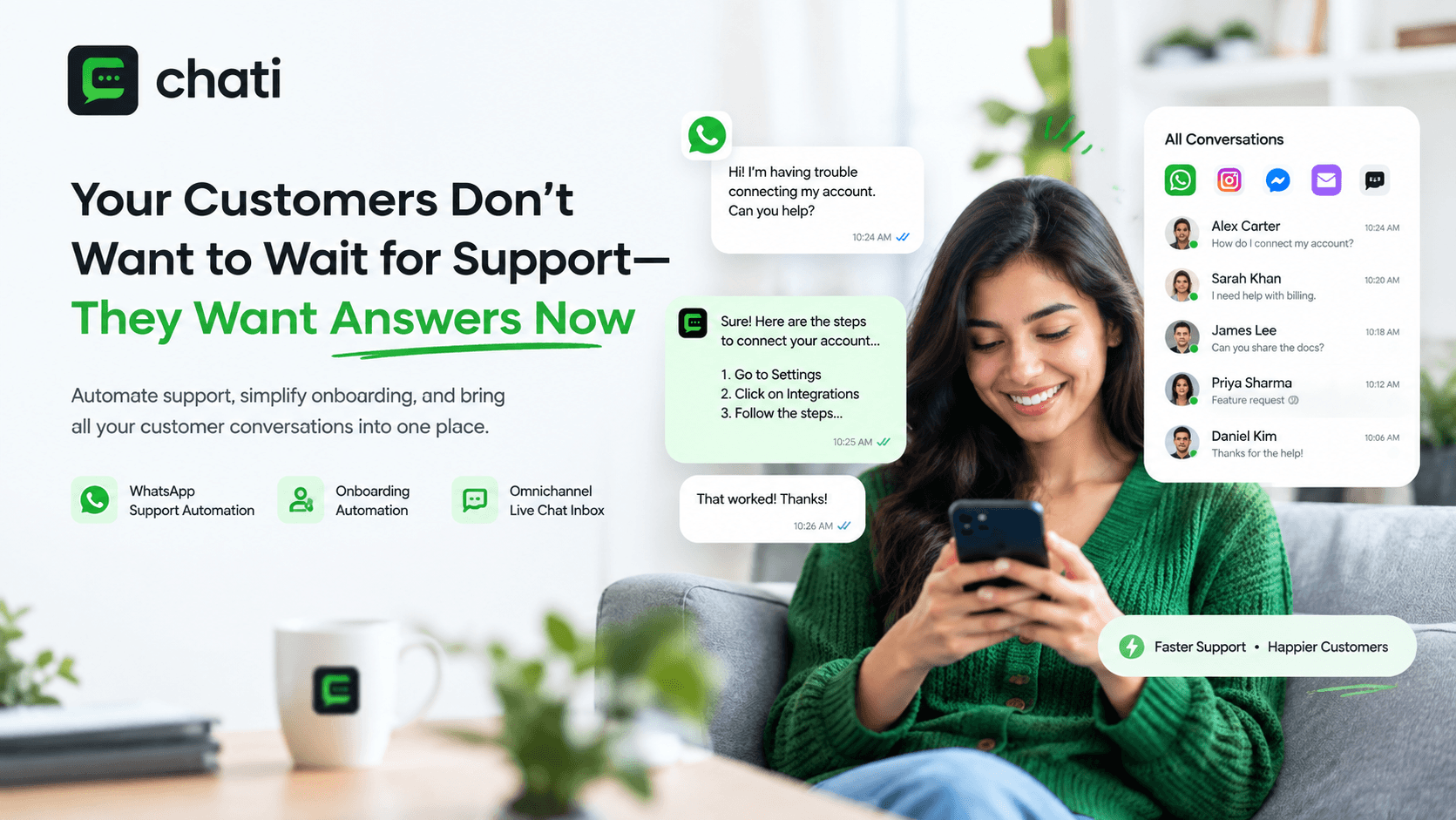
Chati brings WhatsApp, Instagram, Messenger, RCS, SMS and email communication into a single platform, while combining AI chatbots, automation workflows, team collaboration and analytics.
For SaaS businesses specifically, Chati supports automated onboarding, AI-powered troubleshooting, documentation sharing and escalation to human agents.
That means a customer can ask a question and get an immediate response instead of becoming another ticket waiting in a queue.
And when the AI can't confidently solve the problem, the conversation doesn't have to stop.
It can move to a human agent with the context intact.
A Simple Example
Let's say a SaaS customer messages:
"My API integration isn't working."
A traditional support process might look like this:
Customer → Support inbox → Waiting → Agent asks for details → Customer replies → Agent investigates → More questions → Resolution
That can take hours.
A conversational workflow can be much shorter:
Customer → AI understands the issue → Checks relevant documentation → Provides troubleshooting steps → Customer confirms result → Escalates if unresolved
The important thing is that automation doesn't need to pretend it knows everything.
A good system should know when to answer, when to ask for more information, and when to hand the conversation to a human.
Automation Should Feel Helpful, Not Robotic
This is where many businesses get automation wrong.
They automate everything.
Customers then receive messages like:
"Please select option 1."
"Invalid input."
"Please select from the following menu."
Nobody wants to have a conversation with a phone menu disguised as a chatbot.
Modern customers expect conversational experiences.
They should be able to say:
"I can't connect my account."
instead of figuring out which menu option represents "account connection problem."
The system should understand the intent behind the message and respond accordingly.
Chati's AI chatbot capabilities are designed around intent, conversation context, automated support and escalation to human agents.
That's a much more practical approach to automation.
The Goal Isn't More Automation. It's Less Friction.
This is the bigger lesson.
Businesses don't need automation because automation sounds impressive.
They need it because customers don't want to wait for answers to simple problems.
Your support team shouldn't spend hours answering questions that an AI assistant can resolve in seconds.
Your customers shouldn't have to repeat the same problem to three different agents.
And your sales team shouldn't lose leads simply because nobody replied quickly enough.
The best conversational systems quietly remove these points of friction.
They help customers get started.
They answer common questions.
They identify problems.
They escalate complicated cases.
And they give human teams more time to focus on customers who genuinely need them.
Start With One Customer Problem
You don't have to automate your entire customer journey overnight.
Start with the questions your team answers most often.
Look at your support conversations.
Find the top 10 repetitive questions.
Then ask:
Can this question be answered automatically?
If yes, automate it.
Next, identify where customers commonly get stuck during onboarding.
Build a proactive message around those moments.
Finally, create a clear path to a human agent when automation isn't enough.
That's how conversational automation becomes useful—not because it replaces people, but because it makes every interaction easier.
The Future of Customer Support Is Conversational
Customers aren't becoming more patient.
They're becoming more accustomed to instant answers.
For SaaS companies, that means support can no longer be treated as something that happens only after a customer submits a ticket.
Support needs to become part of the product experience itself.
When customers can ask questions naturally, receive useful answers immediately, and reach a human when they need one, the entire experience becomes smoother.
And that's ultimately what tools like Chati should help businesses achieve:
not more messages, but better conversations.