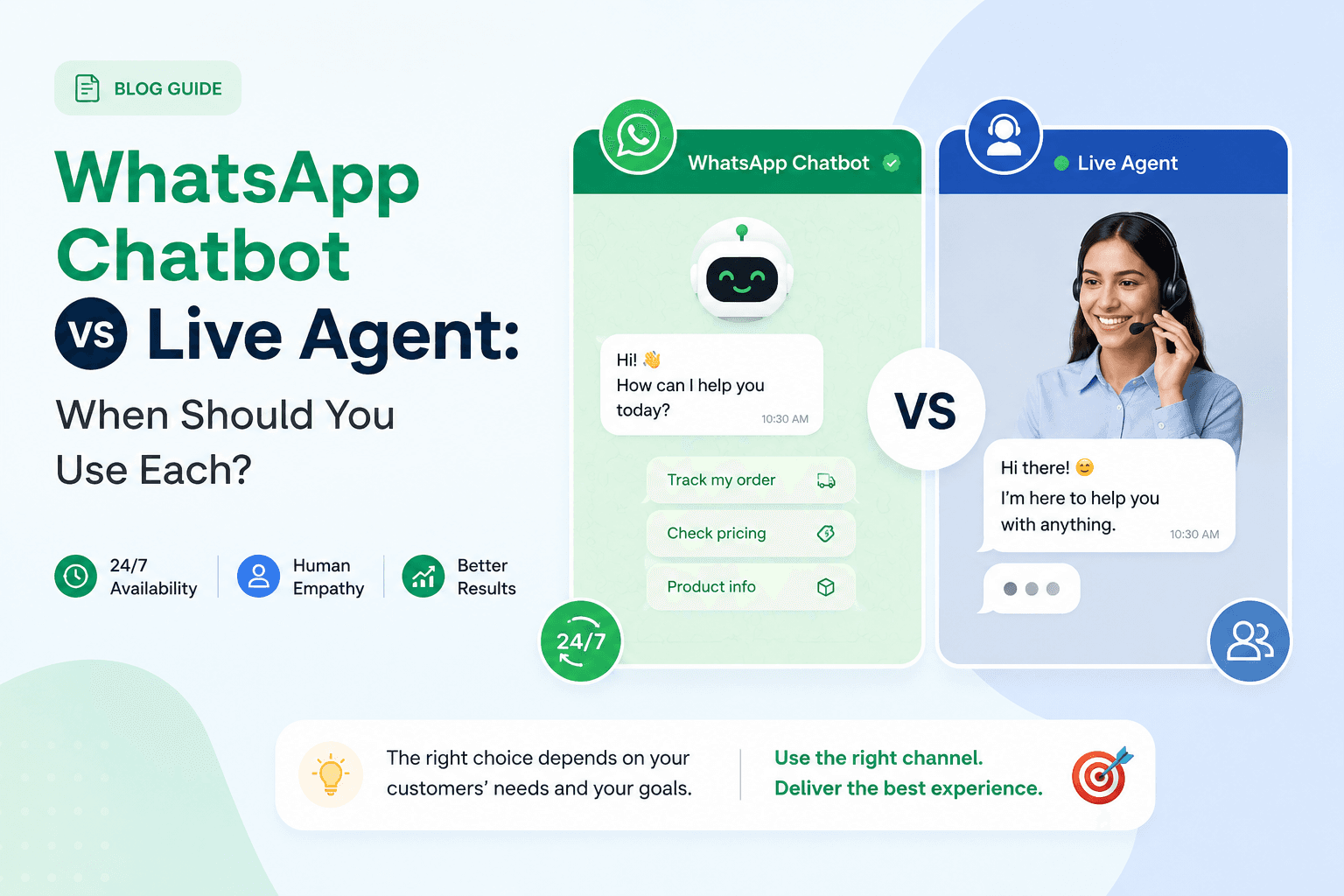
Imagine this.
A customer messages your business on WhatsApp at 11:30 PM asking, "Is my order shipped yet?"
Should a chatbot reply instantly?
Or should a human step in?
The answer isn't as simple as choosing one over the other.
Many businesses think they have to pick between a WhatsApp chatbot and live agents. In reality, the best customer experience comes from knowing when each one should take over.
In this guide, we'll explain the difference, where each works best, and how combining both can improve customer support, sales, and customer satisfaction.
Understanding the Difference
Before deciding which option is better, let's understand what each one does.
What is a WhatsApp Chatbot?
A WhatsApp chatbot is an automated assistant that responds to customer messages without human intervention. It follows predefined workflows or uses AI to understand customer queries.
It can:
Answer FAQs
Share product information
Book appointments
Collect customer details
Track orders
Send payment reminders
Qualify leads
Handle support requests
Since it's available 24/7, customers never have to wait for basic information.
What is a Live Agent?
A live agent is a real customer support representative who interacts personally with customers.
They can understand emotions, solve complex issues, negotiate deals, and make decisions that automation simply cannot.
Whenever empathy, flexibility, or critical thinking is required, human support becomes essential.
When Should You Use a WhatsApp Chatbot?
A chatbot is perfect when customers ask repetitive questions or need quick responses.
Here are some ideal use cases.
1. Answering Frequently Asked Questions
Customers often ask questions like:
What are your business hours?
Do you offer delivery?
What are your pricing plans?
How can I reset my password?
Instead of making customers wait, a chatbot can provide instant answers.
Everyone wins.
2. Lead Generation
Instead of losing potential customers after business hours, a chatbot can collect:
Name
Email
Phone number
Business details
Requirements
Your sales team receives qualified leads the next morning.
3. Order Tracking
Customers love knowing where their order is.
Rather than contacting your support team, they can simply type:
"Track my order"
The chatbot instantly provides shipping updates.
4. Appointment Booking
Whether you're running a clinic, salon, consultancy, or service business, chatbots can manage bookings without manual effort.
Customers can:
Choose dates
Pick time slots
Receive confirmations
Get reminders
5. Payment Reminders
Businesses dealing with recurring payments can automate reminders using a WhatsApp Finance Automation Platform.
Instead of calling customers manually, automated WhatsApp messages can remind users about:
EMI payments
Loan dues
Subscription renewals
Invoice payments
This saves time while improving collection rates.
6. Restaurant Orders
Restaurants receive dozens of similar questions every day.
Examples include:
Menu requests
Table reservations
Delivery status
Operating hours
A WhatsApp chatbot for restaurants can handle these requests instantly while allowing staff to focus on preparing great food and serving guests.
When Should You Use a Live Agent?
Automation is powerful—but it isn't designed for every situation.
Some conversations require a real person.
1. Handling Complaints
Imagine receiving this message:
"My order arrived damaged."
A scripted chatbot may frustrate the customer.
A live agent can apologize, understand the issue, offer a replacement, and rebuild trust.
Human empathy matters.
2. Complex Support Issues
Some problems involve multiple questions, technical troubleshooting, or unusual situations.
Examples include:
Account verification issues
Billing disputes
Refund complications
Technical errors
These situations are better handled by trained support agents.
3. High-Value Sales
When customers are making expensive purchases, they usually want reassurance before buying.
Live agents can
Understand customer needs
Recommend suitable products
Offer personalized pricing
Build confidence
This personal interaction often leads to higher conversions.
4. Emotional Conversations
Customers may be frustrated, confused, or upset.
A chatbot cannot genuinely understand emotions.
A human can listen, reassure, and resolve concerns with care.
Why Businesses Should Use Both
The smartest businesses don't replace humans with chatbots.
They combine them.
Here's how it works:
Customer sends a message.
Chatbot answers simple questions instantly.
If the issue becomes complex, the conversation transfers to a live agent.
The customer doesn't have to repeat information.
This creates a seamless experience while reducing the workload on support teams.
Benefits of Combining Chatbots and Live Agents
Instead of viewing automation and human support as competitors, think of them as teammates.
Some key benefits include:
Faster response times
Reduced customer wait times
Lower support costs
Better customer satisfaction
Higher sales conversions
Improved employee productivity
24/7 customer availability
Customers appreciate getting quick answers while still having access to human assistance when they need it.
The Role of an Omnichannel Messaging Platform
Today's customers don't communicate through just one channel.
Some prefer WhatsApp.
Others choose Instagram, Facebook Messenger, SMS, live chat, or email.
Managing all these conversations separately becomes difficult as your business grows.
An Omnichannel messaging platform brings every customer conversation into a single dashboard.
Your team can respond faster without switching between multiple applications.
When integrated with WhatsApp automation, customers enjoy a consistent experience regardless of where they start the conversation.
Beyond WhatsApp: Expanding Customer Communication
Many businesses are also exploring WhatsApp RCS services for business to create richer customer interactions.
These solutions support interactive messages, branded communication, media sharing, and enhanced customer engagement, making conversations more informative and engaging while complementing existing WhatsApp workflows.
As messaging technology evolves, businesses that combine automation with personalized support are better positioned to meet customer expectations.
So, Which One Should You Choose?
The answer depends on the conversation.
Choose a WhatsApp chatbot when customers need:
Instant responses
Order tracking
Appointment booking
Lead qualification
FAQ support
Payment reminders
Choose a live agent when customers need:
Personalized assistance
Complaint resolution
Complex troubleshooting
Sales consultations
Emotional support
The most effective approach isn't choosing one over the other—it's knowing when to switch from automation to human interaction.
Final Thoughts
Customers expect businesses to be available, responsive, and helpful.
A WhatsApp chatbot delivers speed and efficiency, while live agents bring empathy, expertise, and personalized support.
When these two work together, businesses can reduce operational costs, improve customer satisfaction, and create smoother conversations from the very first message.
Whether you're using a WhatsApp Finance Automation Platform, deploying a WhatsApp chatbot for restaurants, adopting WhatsApp RCS services for business, or managing conversations through an Omnichannel messaging platform, the goal remains the same: deliver fast, reliable, and human-centered customer experiences that build long-term relationships.