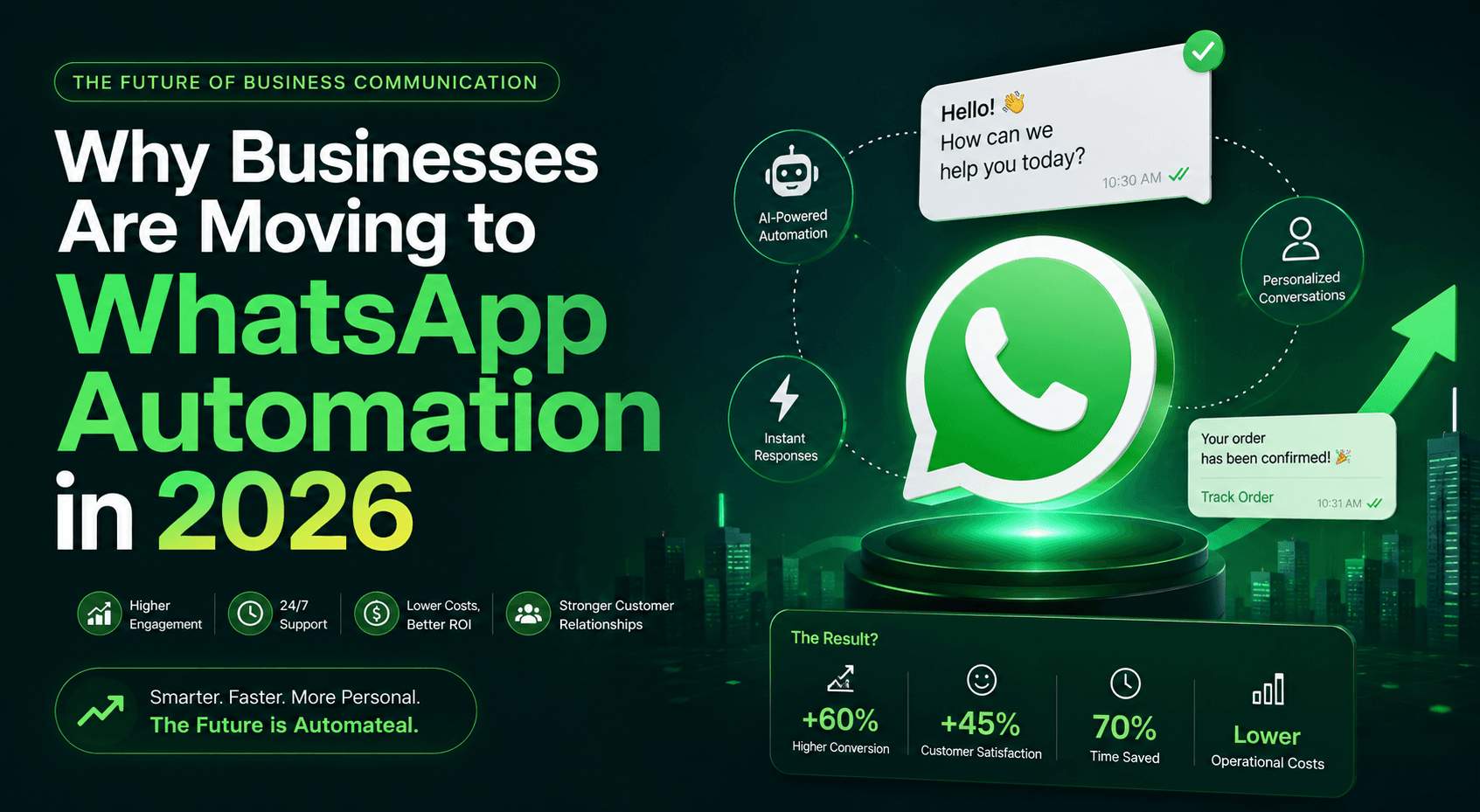
In 2026, businesses are facing one common challenge — customers expect quick replies, smooth communication, and support on the platforms they already use every day. Emails are often ignored, phone calls take time, and mobile apps can feel complicated for many users. But there is one platform customers still open multiple times a day: WhatsApp.
This is why companies across industries are investing in smarter communication systems powered by WhatsApp. From customer support to sales updates, reminders, and marketing campaigns, businesses are using automation to save time and improve customer experience.
For small and medium businesses especially, automation is no longer a luxury. It has become a practical solution for handling customer conversations without increasing team size.
In this blog, we will explore why WhatsApp automation is becoming one of the most important business tools in 2026, the common problems businesses face today, and how automation solves them in a simple and cost-effective way.
The Communication Problem Most Businesses Face
Modern customers expect businesses to respond quickly. Whether someone wants to place an order, ask a question, book a service, or request support, they expect instant communication.
But many businesses still struggle with:
Delayed customer replies
Missed leads after business hours
Managing conversations across multiple platforms
High customer support workload
Poor follow-up processes
Low response rates from email campaigns
Difficulty tracking customer engagement
These problems directly affect sales and customer trust.
For example, if a customer sends a message asking about pricing and receives a reply after six hours, there is a good chance they already contacted another business.
This is where WhatsApp automation creates a major difference.
Why WhatsApp Is Leading Business Communication
WhatsApp has become more than a personal messaging app. Customers now use it for shopping, support, bookings, payments, and service updates.
Businesses prefer WhatsApp because:
Customers already use it daily
Messages have very high open rates
Communication feels personal and direct
It supports images, documents, buttons, and links
Customers can easily continue conversations
In 2026, companies are moving toward conversational business models where customers can interact naturally instead of filling long forms or waiting on calls.
This shift has increased demand for tools like a WhatsApp Marketing Automation Platform and smart support systems.
What Is WhatsApp Automation?
WhatsApp automation helps businesses send messages, reply to customers, and manage conversations automatically using workflows, chatbots, and AI.
Instead of manually replying to every message, businesses can automate repetitive tasks such as:
Welcome messages
Order confirmations
Appointment reminders
Customer support replies
Lead qualification
Payment reminders
Product recommendations
Feedback collection
Automation does not replace human teams completely. Instead, it helps teams focus on important conversations while routine tasks are handled automatically.
How Businesses Benefit from Automation
1. Faster Customer Response
Speed matters.
Customers do not want to wait hours for replies. Automated responses allow businesses to instantly acknowledge customer queries.
Even simple messages like:
“Thank you for contacting us. Our team will reply shortly.”
can improve customer trust.
Advanced automation systems can also answer common questions immediately, such as pricing, timings, order status, or appointment details.
2. Better Lead Conversion
Many businesses lose leads because they fail to follow up quickly.
With automation, every lead can receive:
Instant responses
Product information
Follow-up reminders
Personalized offers
This improves conversion rates without increasing manual work.
For eCommerce companies, automation also helps recover abandoned carts and guide customers toward completing purchases.
This is one reason why many online brands now use WhatsApp API for E-commerce solutions.
3. Reduced Customer Support Pressure
Customer support teams often spend time answering repetitive questions.
Automation reduces this burden by handling common requests automatically.
Examples include:
Delivery updates
Refund status
Appointment scheduling
Business hours
Product availability
This allows support agents to focus on more complex customer issues.
Businesses can also manage conversations from different channels inside one dashboard using an omnichannel live chat inbox.
This improves team productivity and prevents missed messages.
Industries Using WhatsApp Automation in 2026
WhatsApp automation is now being used across many industries.
E-commerce
Online stores use automation for:
Order updates
Payment reminders
Product recommendations
Delivery tracking
Customer feedback
Healthcare
Clinics and hospitals use automation for:
Appointment reminders
Patient communication
Prescription notifications
Follow-up care messages
Education
Schools and institutes use automation for:
Admission inquiries
Class reminders
Fee notifications
Parent communication
Real Estate
Property businesses use automation for:
Lead qualification
Property sharing
Site visit scheduling
Customer follow-ups
Travel and Hospitality
Travel agencies and hotels use automation for:
Booking confirmations
Travel updates
Customer support
Package promotions
Automation helps all these industries improve customer experience while reducing operational workload.
AI Is Making Automation Smarter
One of the biggest trends in May 2026 is the rise of AI-powered communication.
Businesses are no longer using only simple chatbot replies. Modern systems now understand customer intent, provide smarter answers, and route conversations to the right teams.
AI-powered automation can:
Understand customer questions
Recommend products
Translate messages
Detect customer urgency
Personalize communication
Analyze customer behavior
This creates faster and more human-like conversations.
Businesses using AI tools are seeing improvements in customer satisfaction and support efficiency.
The Importance of Personalized Messaging
Customers do not like generic promotional messages anymore.
Modern automation platforms help businesses send personalized messages based on customer behavior.
For example:
Sending offers based on previous purchases
Sharing reminders based on customer activity
Providing location-specific updates
Recommending relevant products
Personalized communication increases engagement and builds stronger customer relationships.
It also reduces message fatigue because customers receive content that actually matters to them.
Multi-Channel Communication Is Becoming Essential
In 2026, customers communicate across multiple platforms.
Some customers prefer WhatsApp, while others use Instagram, Facebook, email, or website chat.
Managing all these conversations separately creates confusion.
Businesses are now moving toward unified communication systems where all conversations appear in one place.
This helps teams:
Respond faster
Track conversations easily
Avoid duplicate replies
Improve customer experience
A centralized support system also helps managers monitor team performance and customer satisfaction.
Automation Helps Small Businesses Compete
Earlier, advanced communication systems were mostly available to large companies.
Today, automation tools are affordable and accessible for small businesses too.
Even a small business can now:
Automate customer replies
Run marketing campaigns
Track customer engagement
Send reminders
Provide faster support
This creates a level playing field.
Customers now expect professional communication regardless of business size.
Automation helps smaller companies deliver better customer experiences without hiring large support teams.
Common Mistakes Businesses Should Avoid
While automation is powerful, businesses should use it carefully.
Here are some common mistakes:
Over-Automation
Customers still want human support when needed.
Businesses should always provide an option to connect with a real person.
Sending Too Many Messages
Too many promotional messages can annoy customers.
Businesses should focus on relevant and useful communication.
Ignoring Customer Data
Automation platforms provide valuable insights.
Businesses should analyze customer behavior, response rates, and engagement data to improve communication strategies.
Poor Message Timing
Sending messages at the wrong time reduces engagement.
Businesses should understand customer activity patterns before scheduling campaigns.
What Customers Expect in 2026
Customer expectations are changing quickly.
Today’s customers want:
Instant communication
Personalized experiences
Easy support access
Faster issue resolution
Mobile-friendly interactions
Secure communication
Businesses that fail to adapt may struggle to retain customers.
Customers now choose brands not only for products or pricing, but also for communication experience.
The Future of Business Communication
The future of communication is conversational, automated, and AI-driven.
Businesses are moving away from traditional communication methods and focusing more on direct customer engagement.
WhatsApp automation is becoming a central part of this transformation because it combines convenience, speed, and personalization.
In the coming years, automation will become even smarter with:
Better AI capabilities
Voice interactions
Advanced analytics
Deeper customer personalization
Improved customer journey tracking
Businesses that start early will have a stronger advantage.
Final Thoughts
In 2026, businesses are under pressure to provide faster and more personalized customer communication.
Customers expect instant replies, smooth support, and easy conversations on platforms they already trust.
WhatsApp automation helps businesses meet these expectations while reducing manual work and improving efficiency.
Whether it is customer support, lead generation, appointment reminders, or marketing campaigns, automation helps businesses save time and improve customer relationships.
The biggest advantage is not just automation itself — it is the ability to create better customer experiences at scale.
Businesses that invest in smart communication systems today will be better prepared for the future of customer engagement.
For companies looking to grow in a competitive market, automation is no longer optional. It is becoming an essential part of modern business success.