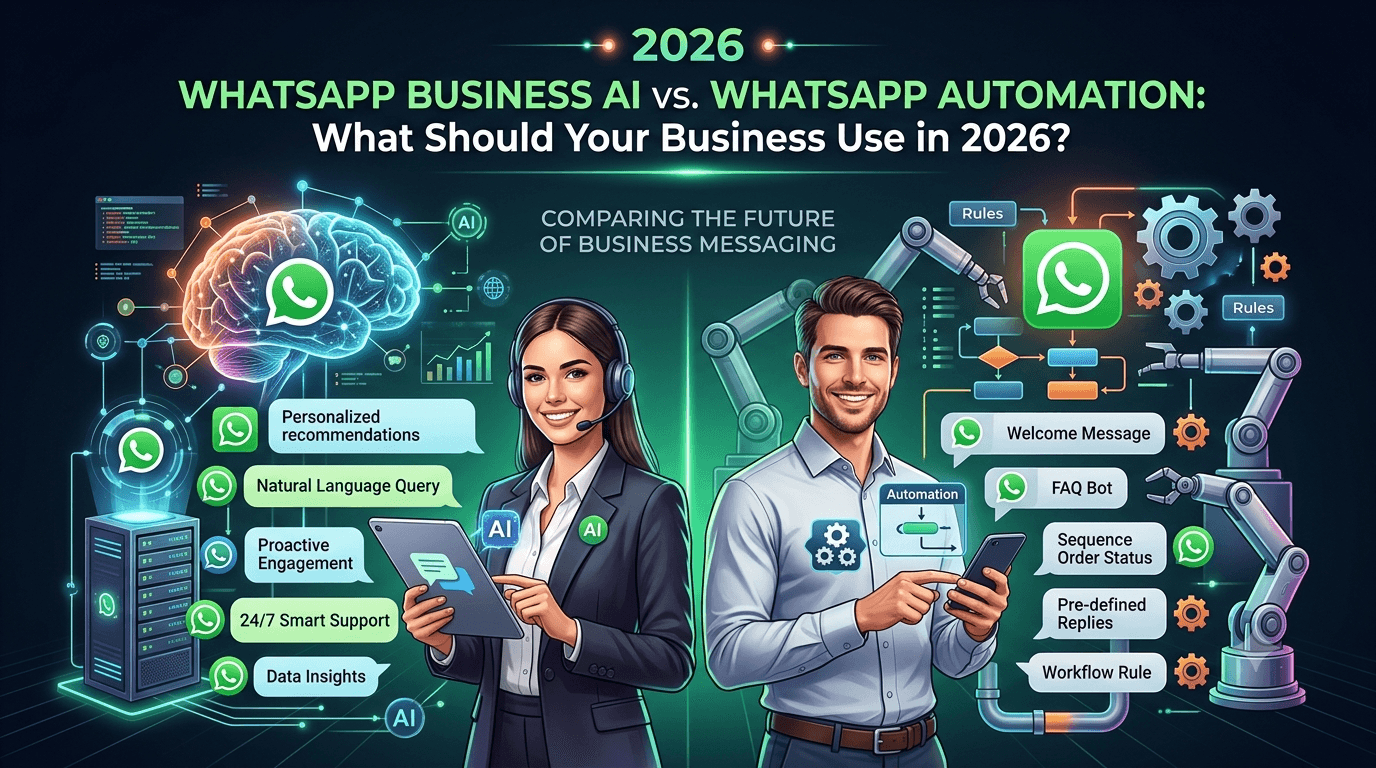
WhatsApp is quickly becoming more than just a messaging app for businesses.
In 2026, businesses can use WhatsApp to answer customer questions, capture leads, recommend products, book appointments, send updates, follow up with prospects, and automate customer support.
But this creates a new question for business owners:
Should you use WhatsApp Business AI, or do you need a WhatsApp automation platform?
The short answer is simple:
WhatsApp Business AI is useful for handling customer conversations and repetitive questions, while WhatsApp automation is better when your business needs structured workflows, lead management, follow-ups, integrations, team collaboration, campaigns, and analytics.
Meta introduced Business AI on WhatsApp for eligible small businesses in India in 2026. It can help businesses answer customer questions, recommend products, capture leads, book appointments, and support sales without requiring additional third-party tools.
But AI conversations and business automation are not exactly the same thing.
Let's look at what businesses should actually use.
What Is WhatsApp Business AI?
WhatsApp Business AI helps businesses automatically handle common customer conversations inside WhatsApp.
For example, a customer might ask:
What are your prices?
Do you deliver to my city?
What are your business hours?
Which product is best for me?
Can I book an appointment?
Is this product available?
How long does delivery take?
Instead of manually answering every question, Business AI can respond using information provided by the business.
Meta says eligible businesses in India can use Business AI to respond to customer queries, recommend products, capture leads, book appointments, and help drive sales.
For a small business receiving the same questions throughout the day, this can be extremely useful.
Is WhatsApp Business AI the Same as a Chatbot?
Not exactly, although there is some overlap.
A traditional chatbot usually works around predefined questions, buttons, menus, and conversation flows.
AI can understand customer questions more naturally and respond based on the information available to it.
For example, instead of asking a customer to select:
1. Pricing
2. Products
3. Support
an AI-powered experience can understand:
"I'm looking for a laptop under ₹70,000 for video editing. What do you recommend?"
That makes AI useful for natural customer conversations.
But answering a customer is only one part of business automation.
Why Isn't WhatsApp Business AI Enough for Every Business?
Imagine your business receives hundreds or thousands of WhatsApp enquiries every month.
Customers are asking questions, but your sales team also needs to:
Capture lead details
Qualify prospects
Assign leads to salespeople
Schedule follow-ups
Send reminders
Update CRM records
Track conversations
Send campaigns
Measure conversions
Escalate conversations to human agents
This is where a dedicated WhatsApp automation platform becomes more useful.
AI can answer a question. Automation can manage the entire customer journey.
That difference becomes important as your business grows.
WhatsApp Business AI vs WhatsApp Automation: What Is the Difference?
Think about the difference this way.
WhatsApp Business AI is conversation-focused.
It helps businesses answer customers and provide information automatically.
WhatsApp automation is workflow-focused.
It determines what should happen before, during, and after a customer conversation.
For example, someone submits a demo request on your website.
A WhatsApp automation workflow could:
Send an instant WhatsApp message.
Ask qualifying questions.
Collect the customer's requirements.
Categorize the lead.
Send the lead to the right salesperson.
Schedule a follow-up.
Send reminders.
Update the CRM.
Re-engage the prospect if they stop responding.
That is much more than a chatbot.
When Should a Small Business Use WhatsApp Business AI?
WhatsApp Business AI can be a good starting point if your main problem is repetitive customer questions.
It can be useful for:
Local businesses
Small retailers
Consultants
Service providers
Restaurants
Appointment-based businesses
Small e-commerce companies
Home businesses
If your biggest problem is:
"We spend too much time answering the same WhatsApp questions."
AI can help.
It can provide faster responses while allowing the business owner or team to focus on more important conversations.
When Should a Business Use WhatsApp Automation?
The answer changes when WhatsApp becomes an important sales, marketing, or customer-support channel.
If you're asking:
"How can we automatically manage our leads and customer conversations?"
you probably need more than basic AI replies.
WhatsApp automation becomes especially useful when you need:
Lead capture
Lead qualification
Automated follow-ups
Sales workflows
Customer support
CRM integration
Appointment booking
Order notifications
Payment reminders
Campaign management
Customer segmentation
Team inboxes
Multiple agents
Analytics
Multi-step workflows
For growing businesses, automation turns WhatsApp from a simple communication tool into part of the customer journey.
What Can Businesses Automate on WhatsApp in 2026?
WhatsApp automation goes far beyond sending an automatic greeting.
Here are some of the most useful workflows businesses can automate.
1. WhatsApp Lead Capture
When someone contacts your business, automation can collect information such as:
Name
Phone number
Location
Product interest
Budget
Requirements
Preferred appointment time
That information can then be routed to the right team.
This is especially useful for real estate, education, healthcare, SaaS, financial services, and other businesses that receive high-intent enquiries.
2. Automated WhatsApp Lead Follow-Up
One of the biggest problems businesses face isn't always generating leads.
It's following up consistently.
A prospect may ask for pricing today and then disappear.
A WhatsApp automation workflow can trigger follow-ups based on customer actions.
For example:
Day 1: Send requested information.
Day 2: Follow up with the prospect.
Day 4: Share additional information.
Day 7: Send a final relevant follow-up.
The exact timing should depend on the customer journey and business.
The important point is that your team doesn't have to remember every follow-up manually.
3. WhatsApp Customer Support Automation
Businesses can automate responses to common questions about:
Pricing
Orders
Shipping
Returns
Availability
Business hours
Locations
Services
Appointment details
When a conversation becomes complicated, it can be transferred to a human agent.
This combination of automation and human support is often more useful than trying to automate everything.
4. WhatsApp Appointment Booking
Customers can start a conversation on WhatsApp and move through the appointment process without calling your business.
This can be useful for:
Clinics
Salons
Consultants
Education businesses
Travel companies
Real estate companies
Professional services
Automation can handle availability questions, collect customer information, send confirmations, and remind customers about upcoming appointments.
5. WhatsApp Order and Delivery Updates
Businesses can automatically send:
Order confirmations
Payment confirmations
Shipping updates
Delivery notifications
Appointment reminders
Service updates
This reduces repetitive work for customer-support teams.
6. WhatsApp Customer Re-Engagement
Not every customer purchases immediately.
Some customers ask for pricing and disappear.
Others request a demo but don't schedule it.
Some start an enquiry but never finish it.
Automation can help businesses re-engage customers based on their previous interactions.
The key is to keep the messages relevant and follow WhatsApp's applicable messaging and consent requirements.
Is WhatsApp Automation Better Than a Chatbot?
Not necessarily.
A chatbot can be one part of a larger automation strategy.
A modern WhatsApp automation setup can combine:
AI + chatbot flows + business rules + integrations + human support + analytics.
For example:
A customer asks a question.
AI understands the intent.
The automation workflow determines what happens next.
A CRM provides customer information.
The system sends the appropriate response.
If the conversation requires human attention, the agent takes over.
This is why businesses shouldn't necessarily think of AI and automation as competing technologies.
They can work together.
What About Businesses With Sales Teams?
This is where automation becomes especially valuable.
Imagine ten salespeople are handling WhatsApp leads manually.
It quickly becomes difficult to know:
Who owns each lead?
Who contacted the prospect?
Which leads need follow-up?
Which prospects are ready to buy?
Which salesperson handled the conversation?
Which campaign generated the lead?
Which leads have gone inactive?
A centralized WhatsApp automation setup can provide much more control over the customer journey.
Instead of treating WhatsApp as individual conversations, businesses can make it part of their sales process.
Can WhatsApp Automation Connect With CRM Systems?
Yes, depending on the platform and implementation.
This is one of the biggest reasons businesses move beyond basic WhatsApp usage.
A business may want WhatsApp connected with:
CRM systems
Website lead forms
E-commerce platforms
Payment systems
Appointment software
Customer databases
Marketing platforms
Analytics tools
Internal business workflows
This can create a connected journey such as:
Website → Lead Capture → WhatsApp → Qualification → CRM → Sales Follow-Up → Conversion
Instead of managing every step separately, businesses can automate the movement of information between different parts of the customer journey.
Is WhatsApp Automation Useful for B2B Companies?
Absolutely.
B2B businesses often have longer sales cycles and require consistent follow-up.
WhatsApp can support:
Demo requests
Lead qualification
Product enquiries
Appointment scheduling
Customer onboarding
Sales follow-ups
Customer support
Renewal reminders
Account updates
For SaaS companies, for example, a WhatsApp workflow could respond to a demo request, qualify the prospect, provide basic information, schedule a meeting, and notify the sales representative.
This allows the sales team to spend more time on high-value conversations.
Which Industries Benefit Most From WhatsApp Automation?
WhatsApp automation can be useful across many industries.
Real Estate
Real estate companies can automate property enquiries, lead qualification, property information, follow-ups, and appointment scheduling.
Healthcare
Healthcare businesses can use WhatsApp for appointment requests, reminders, routine customer communication, and support.
Education
Schools, colleges, coaching institutes, and edtech companies can automate admission enquiries, course information, reminders, and student communication.
E-commerce
Online businesses can use WhatsApp for product enquiries, order updates, customer support, abandoned-cart follow-ups, and customer engagement.
Travel
Travel companies can automate enquiries, booking communication, itinerary updates, reminders, and customer support.
Financial Services
Financial businesses can use WhatsApp for approved customer communication, notifications, onboarding, service enquiries, and support workflows.
SaaS
SaaS companies can use WhatsApp automation to capture leads, qualify prospects, book demos, support customers, and nurture potential buyers.
What Is the Best WhatsApp Automation Strategy for 2026?
The best strategy isn't:
"Automate everything."
It is:
"Automate repetitive work while keeping humans involved where they add the most value."
A strong WhatsApp automation strategy can look like this:
Customer message → AI understands intent → Automation determines the next action → Business system provides information → Customer receives a response → Human takes over when needed
This gives businesses the speed of automation without removing human interaction completely.
Is WhatsApp Business AI Enough for My Business?
Use this simple test.
If you mainly need:
"Answer my customers' common questions."
WhatsApp Business AI may be enough to get started.
If you need:
"Capture, qualify, follow up, route, support, and convert customers automatically."
you should consider a dedicated WhatsApp automation platform.
And if you need both?
Use AI as part of your broader automation strategy.
That's likely to be the more scalable approach for a growing business.
How Chati Helps Businesses Go Beyond Basic WhatsApp Replies
This is where Chati can fit into the picture.
Businesses don't just need a chatbot that says hello.
They need a system that helps them manage the complete customer journey.
Chati helps businesses build WhatsApp-driven customer journeys around lead generation, customer support, follow-ups, automation, and engagement.
Instead of manually managing every conversation, businesses can use automation to keep leads moving and customers informed.
For companies already using WhatsApp for sales or support, the next step isn't necessarily adding another chatbot.
It's building a repeatable WhatsApp automation workflow that connects customer conversations with actual business processes.
You can explore Chati's WhatsApp automation platform to see how automation can fit into your sales and customer communication strategy.
WhatsApp AI vs Automation: What Should You Choose?
If your business is small and your main problem is repetitive customer questions, WhatsApp Business AI can be a useful starting point.
If your business has a growing sales team, multiple customer journeys, high conversation volumes, CRM requirements, or complex follow-ups, dedicated automation becomes more valuable.
And if your goal is to scale WhatsApp as a serious business channel, the strongest approach may be:
AI + WhatsApp automation + human support.
AI handles repetitive conversations.
Automation manages workflows.
Your team handles high-value conversations.
Together, these capabilities can turn WhatsApp from a simple messaging channel into an important part of your sales, support, and customer experience infrastructure.
Frequently Asked Questions
Is WhatsApp Business AI available for businesses?
Meta introduced Business AI on WhatsApp for eligible small businesses in India in 2026. It can help businesses respond to customer questions, recommend products, capture leads, book appointments, and support sales.
Is WhatsApp Business AI the same as WhatsApp Business API?
No.
WhatsApp Business AI is an AI capability designed to assist with customer conversations.
The WhatsApp Business Platform provides infrastructure for programmatic messaging, integrations, automation, and larger-scale business communication.
They can work together, but they serve different purposes.
Can AI handle all WhatsApp customer support?
Not necessarily.
AI is useful for repetitive and straightforward questions, but complex or high-value conversations may require a human agent.
A good WhatsApp automation strategy should make it easy to move a conversation from AI to a human when necessary.
Is WhatsApp automation only for large companies?
No.
Small businesses can also benefit from automation, especially when they receive repetitive enquiries or need consistent follow-up.
The right level of automation depends on the business's conversation volume, customer journey, team size, and processes.
What is better for lead generation: WhatsApp AI or automation?
AI can help answer questions and capture basic information.
Automation becomes more useful when you need lead qualification, routing, follow-ups, CRM updates, and sales handoffs.
Can WhatsApp automation increase sales?
Automation can help businesses respond faster, reduce missed enquiries, maintain consistent follow-up, and keep prospects engaged.
However, automation alone doesn't guarantee sales. Results depend on the quality of the offer, messaging, customer experience, sales process, and audience.
Final Takeaway
WhatsApp is becoming a much more intelligent business communication channel.
With Business AI now available to eligible small businesses in India, businesses have more options for automating customer conversations directly inside WhatsApp.
But businesses shouldn't confuse AI conversations with complete business automation.
AI can answer.
Automation can orchestrate.
Your team can close.
For businesses that want to use WhatsApp seriously for lead generation, sales, customer support, and customer engagement, combining these capabilities can create a much stronger customer journey.
The businesses that benefit most won't simply be the ones sending more WhatsApp messages.
They'll be the ones building better, faster, and more useful customer journeys around WhatsApp.