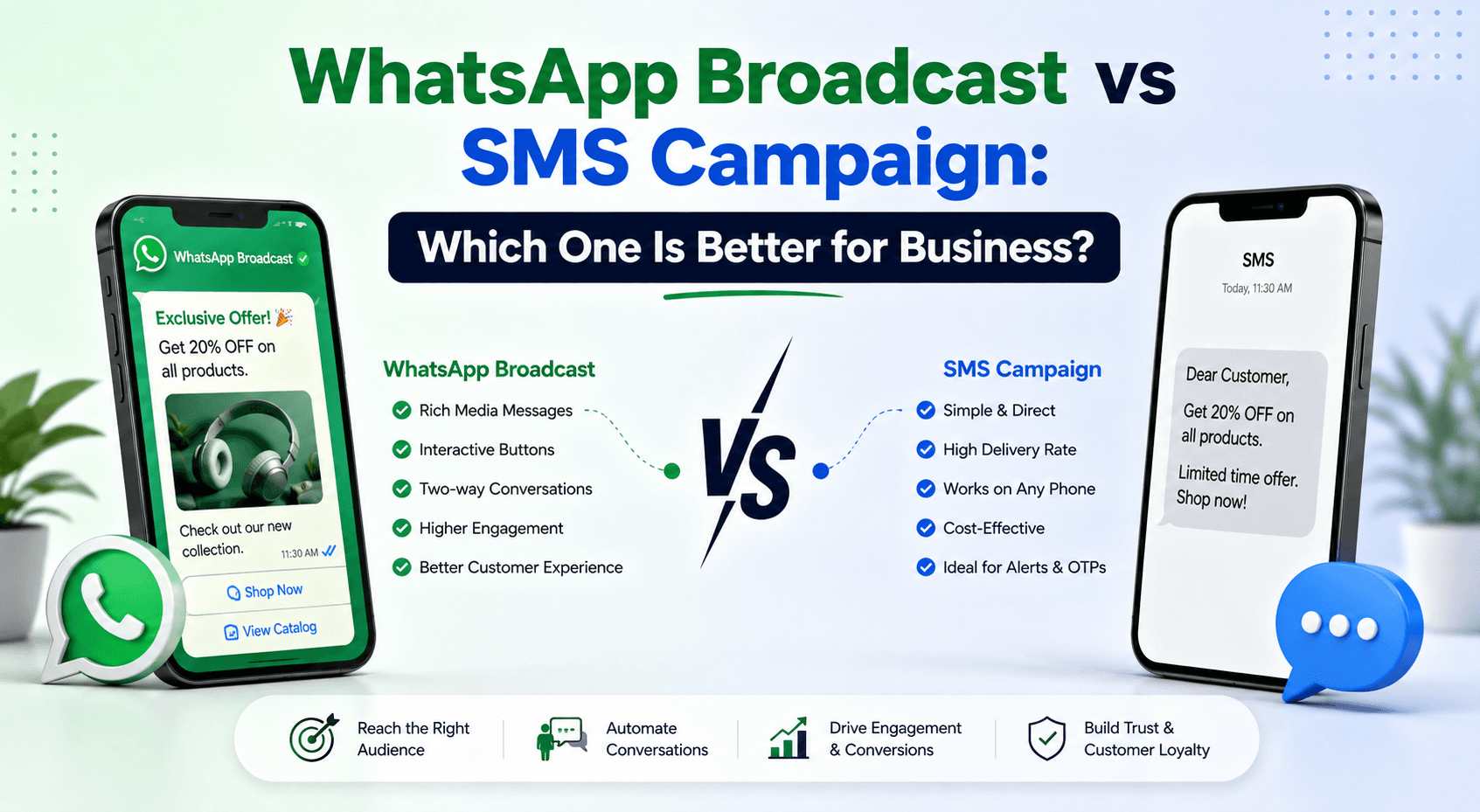
Is WhatsApp Broadcast better than SMS campaigns?
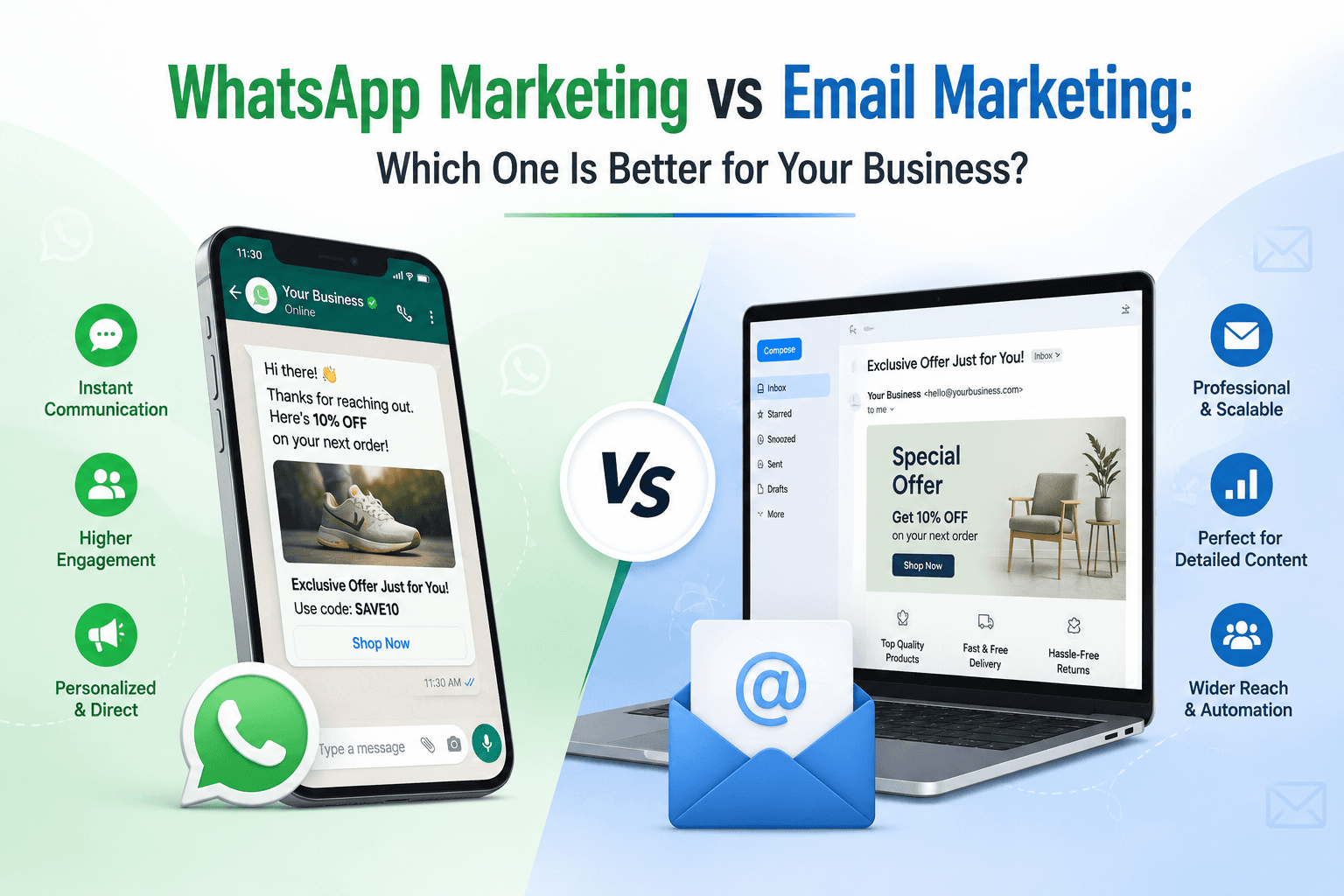
For engagement, conversations, rich media and customer journeys, WhatsApp usually has the advantage. For simple, urgent and universal reach, SMS remains valuable. For many businesses, the strongest strategy is not WhatsApp versus SMS—it is using both channels with the right fallback strategy.
The real question is not simply which channel sends more messages.
It is:
Which channel helps your customer take the next step more easily?
That is where the difference between WhatsApp Broadcast and SMS becomes important.
What is the difference between WhatsApp Broadcast and an SMS campaign?
A WhatsApp Broadcast sends a message to a selected group of customers through WhatsApp, while an SMS campaign delivers a text message directly to a mobile number through telecom networks.
The biggest practical difference is what happens after the message is delivered.
SMS is primarily designed for short, direct communication. WhatsApp can turn a message into a conversation, allowing customers to reply, view media, interact with buttons, open links and continue through an automated customer journey.
WhatsApp Business says its platform is designed to help businesses connect with customers through messaging, and WhatsApp has more than 2 billion users globally.
So instead of asking only about delivery, businesses should consider the complete customer journey:
Message → Interaction → Response → Conversion
That is where WhatsApp can have a significant advantage.
Is WhatsApp better than SMS for marketing?
In many marketing situations, yes—but not always.
WhatsApp is particularly useful when the campaign depends on interaction, context or visual information.
For example:
SMS:
“Your appointment is tomorrow at 10 AM. Call us for details.”
WhatsApp:
“Your appointment is tomorrow at 10 AM. Would you like to confirm or reschedule?”
The WhatsApp version can become an interactive customer journey rather than a simple notification.
Businesses can use WhatsApp for:
Product launches
Promotional campaigns
Real estate leads
Appointment reminders
E-commerce promotions
Education admissions
Travel confirmations
Customer support
Lead qualification
Abandoned-cart follow-ups
Automated onboarding
Drip campaigns
This is why businesses increasingly look at WhatsApp as more than a messaging channel. It can become part of their sales, marketing and customer-support infrastructure.
When should a business choose WhatsApp Broadcast?
Choose WhatsApp when customers may need to interact with the business after receiving the message.
For example, a real estate company could send a property image with the price, location and a call-to-action to book a site visit.
A SaaS company could send an onboarding message and allow the customer to ask questions directly.
A healthcare business could send an appointment reminder with options to confirm or reschedule.
A travel company could send booking information and provide a direct support conversation.
These use cases benefit from WhatsApp broadcast software for businesses because the broadcast can become the starting point for a larger automated journey.
The important point is that broadcasting should not mean sending the same message to everyone without context.
Good broadcasting is:
Relevant audience + useful message + clear action
When is SMS still better than WhatsApp?
SMS is still the better choice when simplicity, urgency or broad mobile reach matters most.
There are situations where a short text message is exactly what the customer needs.
Examples include:
OTPs
Time-sensitive alerts
Short transactional notifications
Simple appointment reminders
Backup communication
Customers who are not reachable through WhatsApp
Critical notifications where another delivery channel is useful
SMS also has an established regulatory framework in India.
TRAI requires businesses sending commercial communications to follow requirements around sender registration, headers, content templates and customer consent.
That means SMS marketing is not simply a matter of uploading phone numbers and pressing “send.”
Compliance needs to be part of the campaign strategy.
Is WhatsApp marketing more personal than SMS?
It can be, but simply using someone's name does not make a message personal.
Consider these two examples.
Basic personalisation:
“Hi Rahul, check out our latest offer.”
Contextual personalisation:
“Hi Rahul, the property you viewed is available for a site visit this Saturday. Would you like to book a 4 PM slot?”
The second message is more useful because it is based on customer context.
That distinction matters.
Businesses should use customer data to improve relevance rather than simply inserting names into bulk messages.
This is where CRM integration, customer data platforms and automation become valuable.
Does WhatsApp have better engagement than SMS?
There is no single engagement percentage that can honestly be applied to every WhatsApp or SMS campaign.
Results vary depending on:
Audience quality
Customer consent
Industry
Message content
Timing
Offer
Customer intent
Sender reputation
Geography
Campaign frequency
Conversion process
Therefore, businesses should not judge campaigns only by delivery or open-style metrics.
A better approach is to measure what happens after the message.
Track metrics such as:
Delivery rate
Response rate
Click rate
Conversation rate
Qualified leads
Appointment bookings
Purchases
Cost per lead
Cost per conversion
Revenue generated
Unsubscribe or opt-out rate
For WhatsApp campaigns, click tracking for WhatsApp marketing and conversation tracking can help businesses understand which messages actually produce meaningful actions.
The important metric is not:
“How many messages did we send?”
It is:
“How many useful customer actions did those messages generate?”
Which is cheaper: WhatsApp or SMS?
There is no universal answer.
The actual cost depends on several factors, including:
Country
Message category
WhatsApp pricing
SMS route
Telecom provider
Messaging volume
Platform fees
Automation requirements
Customer-support requirements
Businesses should therefore compare the cost of achieving an outcome, rather than only comparing the cost of sending one message.
For example:
Cost per message → Cost per conversation → Cost per qualified lead → Cost per sale
A cheaper message is not necessarily the better channel if it produces fewer conversions.
Can WhatsApp and SMS work together?
Yes. For many businesses, combining both channels can be more effective than choosing only one.
Instead of treating WhatsApp and SMS as competing channels, businesses can create a coordinated messaging journey.
A typical workflow could look like this:
Send the primary campaign through WhatsApp.
Track whether the message is delivered.
Track customer interaction where appropriate.
If the customer does not receive the message and the business rule allows it, trigger an SMS fallback.
If the customer responds on WhatsApp, stop unnecessary follow-up messages.
Send qualified conversations to the CRM or sales team.
Continue the customer journey through the most appropriate channel.
This is where automated drip campaigns with fallback messaging can become useful.
The objective is not to send more messages.
The objective is to make sure the customer receives the right message through the right channel without creating unnecessary communication.
What is WhatsApp and SMS fallback messaging?
Fallback messaging means using another communication channel when the preferred channel cannot successfully reach the customer or complete the intended journey.
For example:
Primary channel: WhatsApp
Fallback channel: SMS
Imagine a customer needs an important booking reminder.
The business first attempts to communicate through WhatsApp. If the customer cannot be reached through the defined workflow, an SMS can provide a simple backup notification.
This approach can be particularly useful for:
Travel bookings
Healthcare appointments
Financial notifications
Education reminders
E-commerce orders
SaaS onboarding
Real estate follow-ups
The fallback should be based on clear business rules rather than automatically sending the same message across every channel.
Should businesses use WhatsApp or SMS for lead follow-up?
Use WhatsApp when the lead needs a conversation. Use SMS when the message needs to be short, immediate or serve as a fallback.
For example:
Real estate
WhatsApp can handle:
Property details
Photos
Lead qualification
Site-visit scheduling
Agent handoff
Follow-up conversations
This makes WhatsApp lead automation for real estate agents particularly useful for businesses managing a large number of incoming enquiries.
Healthcare
WhatsApp can support:
Appointment reminders
Confirmation
Rescheduling
Patient communication
Automated reminders
For simple urgent notifications, SMS can provide an additional communication channel.
Education
WhatsApp can support:
Admission enquiries
Course information
Counsellor conversations
Application follow-ups
Class reminders
For example, an admission open message for school can bring the parent into a conversation rather than ending with a one-way SMS.
Travel
WhatsApp can support:
Booking confirmations
Travel itineraries
Reminder messages
Customer questions
Support conversations
This makes WhatsApp useful for businesses building automated travel communication journeys.
SaaS
WhatsApp can support:
New-user onboarding
Product guidance
Automated reminders
Support questions
Sales follow-ups
A business can combine WhatsApp with email and SMS to create a broader customer lifecycle instead of depending on a single channel.
What about WhatsApp compliance and consent?
Consent should be treated as part of campaign architecture, not an afterthought.
For commercial SMS communication in India, TRAI has requirements covering areas such as sender registration, headers, content templates and customer consent.
TRAI also provides mechanisms through which customers can manage consent and preferences for commercial communication.
Businesses using WhatsApp should likewise follow applicable WhatsApp business messaging policies and ensure that their messaging is expected and relevant to customers.
This becomes especially important for regulated industries such as:
Finance
Healthcare
Education
Insurance
Real estate
A campaign that generates engagement but creates compliance problems is not a successful campaign.
Trust is part of marketing performance.
What is the best strategy for WhatsApp and SMS in 2026?
The best strategy is usually channel orchestration rather than channel selection.
Use WhatsApp when you need:
Two-way conversation
Rich media
Interactive actions
Lead qualification
Customer support
Automated journeys
Personalised engagement
Use SMS when you need:
Broad mobile reach
Short alerts
Time-sensitive notifications
Simple communication
A fallback channel
Use both when the customer journey genuinely benefits from having multiple communication paths.
The future of business messaging is not about sending the maximum number of messages.
It is about understanding which customer should receive which message, through which channel, at which stage of the journey.
WhatsApp Broadcast vs SMS: Which One Should Your Business Choose?
If your goal is engagement, conversation and automated customer journeys, WhatsApp is usually the stronger option.
If your goal is simple alerts, urgency and broad mobile reach, SMS remains highly useful.
If reliability and customer experience are priorities, combining WhatsApp with SMS fallback can be the most practical approach.
The real shift is from bulk messaging to intelligent messaging automation.
Instead of asking:
“Should we use WhatsApp or SMS?”
Ask:
“What does the customer need to do next, and which channel makes that action easiest?”
That is the question that leads to better customer experiences—and better campaign results.