WhatsApp has evolved far beyond a simple messaging app for businesses.
Today, customers use WhatsApp to ask questions, request product information, book appointments, track orders, communicate with support teams, and make purchasing decisions.
For businesses, this creates a significant opportunity—but also a challenge.
How do you consistently respond to every customer, follow up with every lead, and keep conversations moving without increasing your team's workload?
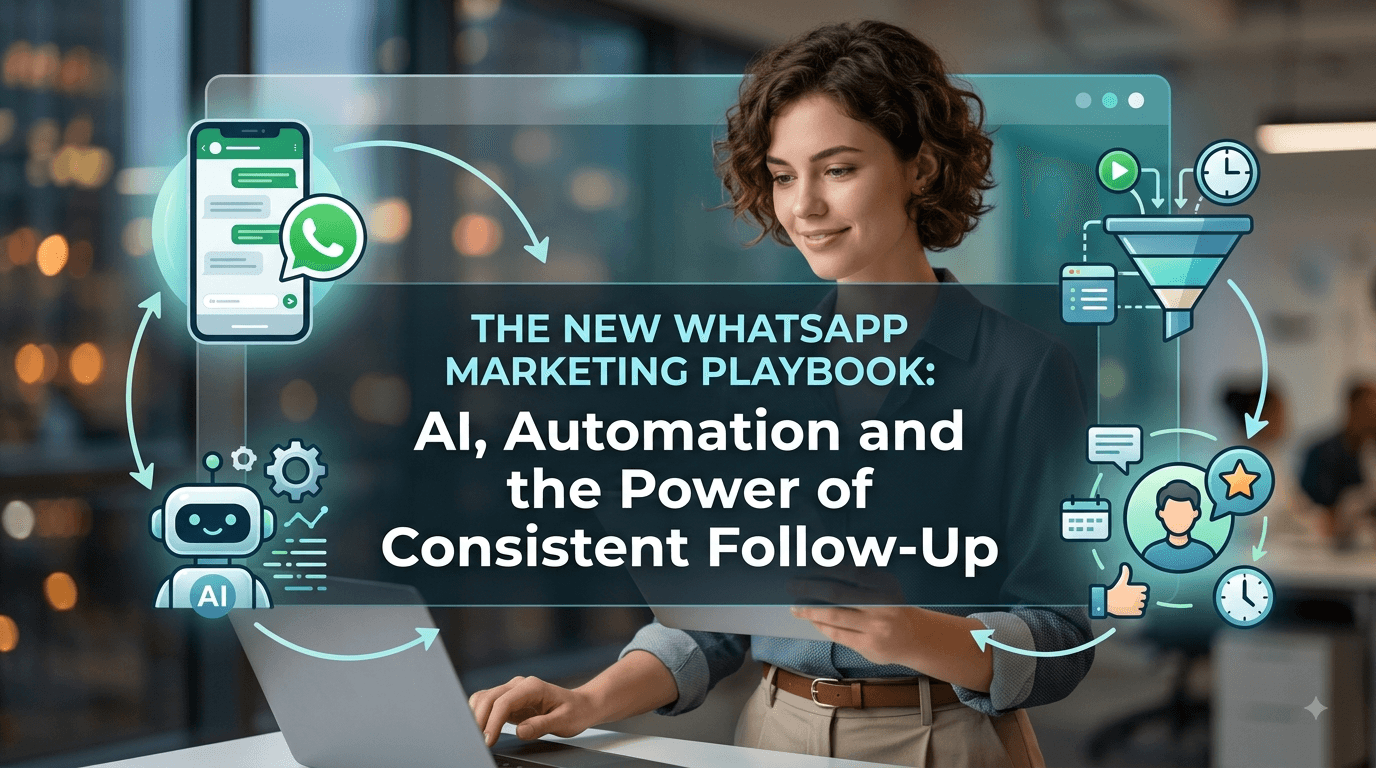
The answer lies in combining WhatsApp marketing automation, AI chatbots, and structured follow-up campaigns.
The new WhatsApp marketing playbook isn't about sending more messages.
It's about creating better conversations at the right time.
What Is WhatsApp Marketing Automation?
WhatsApp marketing automation is the use of software, workflows, AI, and integrations to automate customer communication and marketing activities on WhatsApp.
Instead of manually managing every conversation, businesses can automate repetitive activities such as:
Lead capture
Instant responses
Lead qualification
Follow-up messages
Drip campaigns
Appointment reminders
Customer onboarding
Order notifications
Customer support
Re-engagement campaigns
Broadcast messaging
Sales notifications
The objective is simple:
Deliver the right message to the right customer at the right time—without requiring your team to manually manage every interaction.
This makes WhatsApp automation particularly valuable for businesses handling large numbers of leads or customer conversations.
Why Is Consistent Follow-Up So Important for WhatsApp Marketing?
Getting a lead is only the beginning.
A potential customer might contact your business today but not be ready to purchase immediately. They may want to compare alternatives, discuss the purchase with someone else, ask additional questions, or simply forget about the conversation.
Without follow-up, that opportunity can disappear.
Manual follow-up creates another problem: inconsistency.
Sales representatives may forget to follow up, respond too late, or prioritize one lead while another receives no response.
Automation helps eliminate this gap.
A business can create predefined follow-up journeys that continue communicating with prospects based on their actions and stage in the customer journey.
For example:
Day 0: Welcome and enquiry confirmation
Day 1: Product information
Day 3: Helpful educational content
Day 5: Customer success story
Day 7: Sales or consultation CTA
Instead of relying on memory, the system handles the follow-up automatically.
How Does AI Change WhatsApp Marketing?
Traditional automation works primarily through predefined rules.
For example:
If a customer submits a form → send a welcome message.
AI can make the interaction more conversational.
An AI powered chatbot can understand questions, identify customer intent, provide relevant information, collect details, qualify leads, and transfer conversations to human agents when necessary.
Consider a SaaS company receiving this message:
"We have around 50 employees. Which plan would work for us?"
A basic autoresponder might provide a generic pricing page.
An AI chatbot can understand the requirement, ask relevant questions, explain available options, and potentially route the qualified lead to a sales representative.
This changes WhatsApp from an automated notification channel into a conversational sales and support channel.
What Is the Difference Between a WhatsApp Chatbot and WhatsApp Automation?
A WhatsApp chatbot and WhatsApp automation are closely related, but they serve different purposes.
What Is a WhatsApp Chatbot?
A WhatsApp chatbot is designed primarily to communicate with customers through automated conversations.
It can help businesses:
Answer frequently asked questions
Provide product or service information
Collect customer details
Qualify leads
Recommend products or services
Schedule appointments
Handle common support requests
Transfer conversations to human agents
AI-powered chatbots can also understand natural-language questions and provide more contextual responses instead of relying only on fixed messages.
What Is WhatsApp Automation?
WhatsApp automation is a broader system for automating customer communication and business workflows.
It can include:
Automated lead capture
Follow-up messages
Drip campaigns
WhatsApp broadcasts
Appointment reminders
Customer onboarding
Order notifications
Lead routing
Customer segmentation
Campaign tracking
Automated support workflows
Human handoff
In other words, a chatbot focuses primarily on the conversation, while automation manages the overall customer journey.
Can WhatsApp Chatbots and Automation Work Together?
Yes. In fact, combining them is often more effective than using either one alone.
For example:
Step 1: A customer clicks a WhatsApp campaign.
Step 2: An automated workflow starts the conversation.
Step 3: An AI chatbot answers questions and qualifies the lead.
Step 4: The lead is added to an appropriate follow-up sequence.
Step 5: Automated messages continue nurturing the lead.
Step 6: A sales representative takes over when human interaction is required.
This creates a complete customer journey instead of a single automated conversation.
What Is the Main Difference?
The simplest way to understand the difference is:
WhatsApp chatbot = automated conversation.
WhatsApp automation = automated customer journey.
A modern WhatsApp marketing strategy can combine both to handle conversations, follow-ups, campaigns, sales, and customer support more efficiently.
Automation creates consistency. AI adds intelligence.
How Should a Modern WhatsApp Marketing Funnel Work?
A successful WhatsApp funnel doesn't stop after the first message.
It should guide the customer from initial interest through conversion and retention.
1. Capture the Lead
Customers can enter your WhatsApp funnel through:
Website forms
Click-to-WhatsApp campaigns
QR codes
Landing pages
Social media
Existing customer databases
Advertising campaigns
The objective is to start a relevant, permission-based conversation.
2. Respond Immediately
Speed matters.
When someone contacts your business, an automated response can acknowledge the enquiry immediately.
For example:
"Thanks for contacting us. What would you like help with today?"
The customer can then select an option or type their requirement.
3. Qualify the Lead
Not every lead has the same level of purchase intent.
Automation can collect information such as:
Product or service interest
Budget
Location
Company size
Preferred date
Business requirement
Purchase timeline
This information helps sales teams prioritize high-intent opportunities.
4. Nurture the Prospect
Some customers need time before purchasing.
This is where automated drip campaigns become useful.
Instead of sending one message and waiting, businesses can create a sequence of useful and relevant communications.
The content could include:
Educational information
Product benefits
Case studies
FAQs
Customer testimonials
Special offers
Consultation invitations
The goal isn't to repeatedly sell.
The goal is to remain useful and relevant throughout the buying journey.
5. Convert and Retain
WhatsApp automation shouldn't stop once someone becomes a customer.
Businesses can continue using automated communication for:
Onboarding
Order updates
Appointment reminders
Feedback
Renewals
Upsells
Cross-sells
Re-engagement
This turns WhatsApp into a customer lifecycle channel rather than simply a lead-generation tool.
Why Are Drip Campaigns Still Important in the Age of AI?
AI is changing customer communication, but structured campaigns remain extremely useful.
Imagine a SaaS customer starts a free trial.
They may need:
A welcome message
Setup instructions
Product education
A reminder to complete onboarding
Help from support
An upgrade invitation
There is little reason for a marketing team to manually send every message.
A drip campaign can manage the predictable sequence automatically.
AI can then step in when the customer asks something unexpected.
This creates a powerful combination:
Drip automation manages the journey. AI manages the conversation.
What Is Fallback Messaging and Why Does It Matter?
Automation cannot predict every possible customer question.
A customer might ask something outside the chatbot's configured knowledge or provide an unexpected response.
This is where fallback messaging becomes important.
Instead of leaving the customer without an answer, the system can:
Acknowledge the question.
Explain that additional assistance may be required.
Provide relevant options.
Transfer the conversation to a human agent when necessary.
A good automated experience should never make customers feel trapped inside a bot.
The best automation knows when to involve a human.
How Can Businesses Combine WhatsApp Marketing and Customer Support?
Marketing and customer support are often treated as separate functions.
But customers don't necessarily think in those categories.
Someone who starts with a product question might become a sales lead. A customer asking about an order might need support. A support conversation might create an upsell opportunity.
A modern WhatsApp customer support automation tool can help businesses handle repetitive questions automatically while allowing human teams to take over when a conversation requires personal attention.
For example:
AI handles:
"Which plan should I choose?"
Automation handles:
"Your appointment is tomorrow at 10 AM."
Human support handles:
"I have a problem with my account and need help."
The goal isn't to remove human interaction.
It's to make human interaction more valuable.
Should Businesses Use WhatsApp Broadcast Messaging?
WhatsApp broadcast messaging can be useful for reaching existing customers and opted-in audiences with relevant updates.
Businesses can use broadcasts for:
Product launches
Promotions
Events
Educational content
Appointment reminders
Customer updates
Re-engagement campaigns
However, sending the same message to everyone is rarely the best approach.
Segmentation can make campaigns more relevant.
For example, an e-commerce business could segment customers into:
New customers
Repeat customers
High-value customers
Inactive customers
Customers interested in a specific category
Each audience can then receive communication relevant to its interests or relationship with the business.
The objective should be relevance, not message volume.
How Can Businesses Measure WhatsApp Marketing Performance?
Sending thousands of messages doesn't automatically mean a campaign was successful.
Businesses need to understand what happens after each message.
Important metrics include:
Delivery Rate
How many messages were successfully delivered?
Read Rate
How many recipients opened the message?
Click-Through Rate
How many people clicked the campaign CTA or link?
Response Rate
How many recipients responded?
Lead Conversion Rate
How many conversations became qualified leads or customers?
Revenue
How much revenue did the campaign generate?
Cost Per Acquisition
How much did the business spend to acquire each customer?
These metrics help businesses move beyond vanity metrics and understand the actual commercial value of WhatsApp marketing.
Why Is Click Tracking Important for WhatsApp Marketing?
Clicks are useful, but clicks alone don't tell the complete story.
Imagine two campaigns:
Campaign A
10,000 delivered
800 clicks
40 sales
Campaign B
6,000 delivered
600 clicks
75 sales
Campaign B generated fewer clicks but significantly more customers.
That is why businesses need to track the complete customer journey.
WhatsApp Click tracking can help marketers understand which campaigns, links, CTAs, and offers generate meaningful engagement.
The ultimate goal isn't more clicks.
It's more qualified conversations and conversions.
How Can SaaS Companies Use WhatsApp Automation?
SaaS businesses can use WhatsApp automation across almost the entire customer lifecycle.
A typical journey could look like:
Lead → Qualification → Demo → Trial → Onboarding → Activation → Upgrade → Renewal
For example:
A prospect requests a product demo.
An automated WhatsApp conversation confirms the request and collects basic information.
The lead is qualified and routed to sales.
After the demo, automated follow-ups provide useful resources.
Once the customer starts a trial, onboarding messages help them reach important product milestones.
If engagement decreases, an automated re-engagement campaign can encourage the customer to return.
This makes WhatsApp useful not only for acquisition but also for activation and retention.
How Can E-Commerce Businesses Use WhatsApp Automation?
E-commerce businesses can use WhatsApp throughout the buying journey.
Common use cases include:
Product enquiries
Order confirmations
Shipping updates
Abandoned-cart reminders
Customer support
Product recommendations
Promotional campaigns
Repeat-purchase reminders
Review requests
Instead of forcing customers to move between multiple communication channels, businesses can provide useful updates and assistance through WhatsApp.
The result can be a more convenient customer experience and a more connected sales journey.
Can WhatsApp Automation Work for Healthcare, Education, Travel and Real Estate?
Yes.
WhatsApp automation can be adapted to different industries, although each industry has different requirements, workflows, and compliance considerations.
Healthcare
Possible use cases include appointment reminders, scheduling, FAQs, and patient communication.
Education
Institutions can automate enquiries, admissions communication, reminders, and student updates.
Travel
Travel businesses can automate booking confirmations, itinerary updates, reminders, and customer enquiries.
Real Estate
Real estate businesses can automate property enquiries, lead qualification, viewing reminders, and follow-ups.
Restaurants
Restaurants can use WhatsApp for reservations, menu enquiries, promotions, order updates, and customer support.
The technology changes very little.
The workflow changes according to the customer's needs.
What Should You Look for in a WhatsApp Marketing Automation Platform?
Choosing a platform shouldn't be based only on how many messages it can send.
Businesses should evaluate whether the platform can support the complete customer journey.
Important capabilities include:
WhatsApp Business API integration
AI chatbots
Workflow automation
Drip campaigns
Lead qualification
Broadcast campaigns
Customer segmentation
Human handoff
Campaign analytics
Click tracking
Customer data management
Multi-channel conversations
Personalization
Business integrations
The right platform should reduce repetitive work while improving the customer experience.
Why Is Conversational Marketing the Future of WhatsApp?
Traditional marketing often looks like this:
Send message → Wait → Send another message → Hope for conversion
Conversational marketing takes a different approach:
Customer interacts → AI responds → Intent is identified → Automation takes action → Human joins when needed
This creates a more dynamic customer journey.
Instead of treating every customer as another number on a broadcast list, businesses can respond according to customer intent and behaviour.
That is the real opportunity behind AI-powered WhatsApp marketing.
How Does Chati.ai Fit Into the New WhatsApp Marketing Playbook?
Chati.ai helps businesses bring AI conversations, WhatsApp automation, customer engagement, and follow-up workflows together.
Instead of relying entirely on manual responses, businesses can build automated journeys that help capture, qualify, nurture, and support customers.
A typical workflow can move from:
Lead capture
↓
Instant response
↓
AI qualification
↓
Automated follow-up
↓
Human handoff
↓
Conversion
↓
Customer retention
The goal isn't to automate every customer interaction.
It's to automate repetitive work while allowing your team to focus on conversations that need human attention.
Ready to Make WhatsApp Work Harder for Your Business?
If your team is still manually responding to every enquiry and following up with leads one by one, there is an opportunity to automate a large part of that process.
With AI chatbots, automated workflows, drip campaigns, and measurable customer journeys, WhatsApp can become much more than a messaging channel.
It can become an automated growth channel.
Explore Chati.ai and start building smarter WhatsApp customer journeys.
Frequently Asked Questions About WhatsApp Marketing Automation
What is WhatsApp marketing automation?
WhatsApp marketing automation uses software, workflows, AI, and integrations to automate customer communication on WhatsApp. It can be used for lead generation, follow-ups, customer support, onboarding, reminders, broadcasts, and re-engagement.
How does an AI WhatsApp chatbot work?
An AI WhatsApp chatbot interprets customer messages, understands intent, provides relevant responses, collects information, and can transfer conversations to human agents when required.
Can WhatsApp automation generate leads?
Yes. Businesses can use automated WhatsApp conversations to capture enquiries, ask qualification questions, collect customer information, and route high-intent leads to sales teams.
What are WhatsApp drip campaigns?
WhatsApp drip campaigns are automated sequences of messages sent according to a predefined schedule or customer actions. They can be used for lead nurturing, onboarding, education, reminders, and re-engagement.
Can WhatsApp automation be used for SaaS?
Yes. SaaS businesses can use WhatsApp automation for lead qualification, demo booking, trial onboarding, customer support, product education, re-engagement, upgrades, and renewals.
Can AI replace human customer support on WhatsApp?
AI can automate repetitive questions and first-line support, but human agents remain important for complex, sensitive, or high-value conversations. The strongest approach combines AI automation with human handoff.
How can I measure WhatsApp marketing campaigns?
Common metrics include delivery rate, read rate, click-through rate, response rate, qualified leads, conversions, revenue, and cost per acquisition.
Is WhatsApp broadcast marketing effective?
It can be effective when businesses communicate with relevant, permission-based audiences and use segmentation. Sending large volumes of irrelevant messages is unlikely to produce strong long-term results.
How much does WhatsApp marketing automation cost?
The cost depends on the platform, WhatsApp Business API setup, messaging volume, automation requirements, AI usage, integrations, and applicable WhatsApp or Meta charges. Businesses should evaluate the total cost against the operational savings and revenue generated.
What is the best WhatsApp marketing automation strategy?
A strong strategy typically combines immediate responses, lead qualification, personalized follow-ups, drip campaigns, AI-assisted conversations, human handoff, and campaign measurement.
Is WhatsApp automation suitable for small businesses?
Yes. Small businesses can start with simple use cases such as instant responses, lead capture, FAQs, appointment reminders, follow-ups, and customer support, then expand their automation as their customer volume grows.
Final Takeaway
The future of WhatsApp marketing isn't about sending more messages.
It's about responding faster, following up consistently, understanding customer intent, and creating relevant conversations at scale.
AI provides intelligence.
Automation provides consistency.
Analytics provide visibility.
Human agents provide the personal connection.
Together, they create a WhatsApp marketing system designed not just to communicate but to generate, nurture, convert, and retain customers.
That's the new WhatsApp marketing playbook.