If you're trying to reach more customers, increase sales, and improve customer relationships, you've probably asked this question:
Should I invest in WhatsApp marketing or email marketing?
The short answer is that both are valuable—but they solve different business problems.
In this guide, we'll explain the differences in simple language, show when to use each channel, and help you choose the right strategy for your business.
What Is WhatsApp Marketing?
WhatsApp marketing is the process of communicating with customers through WhatsApp Business. Businesses use it to send promotions, order updates, appointment reminders, payment reminders, customer support messages, and personalized offers.
Unlike traditional marketing channels, WhatsApp feels like a conversation instead of an advertisement, which often leads to higher engagement.
What Is Email Marketing?
Email marketing allows businesses to send newsletters, promotional campaigns, product updates, invoices, educational content, and personalized offers directly to customers' inboxes.
It works especially well for long-form communication and nurturing customers over time.
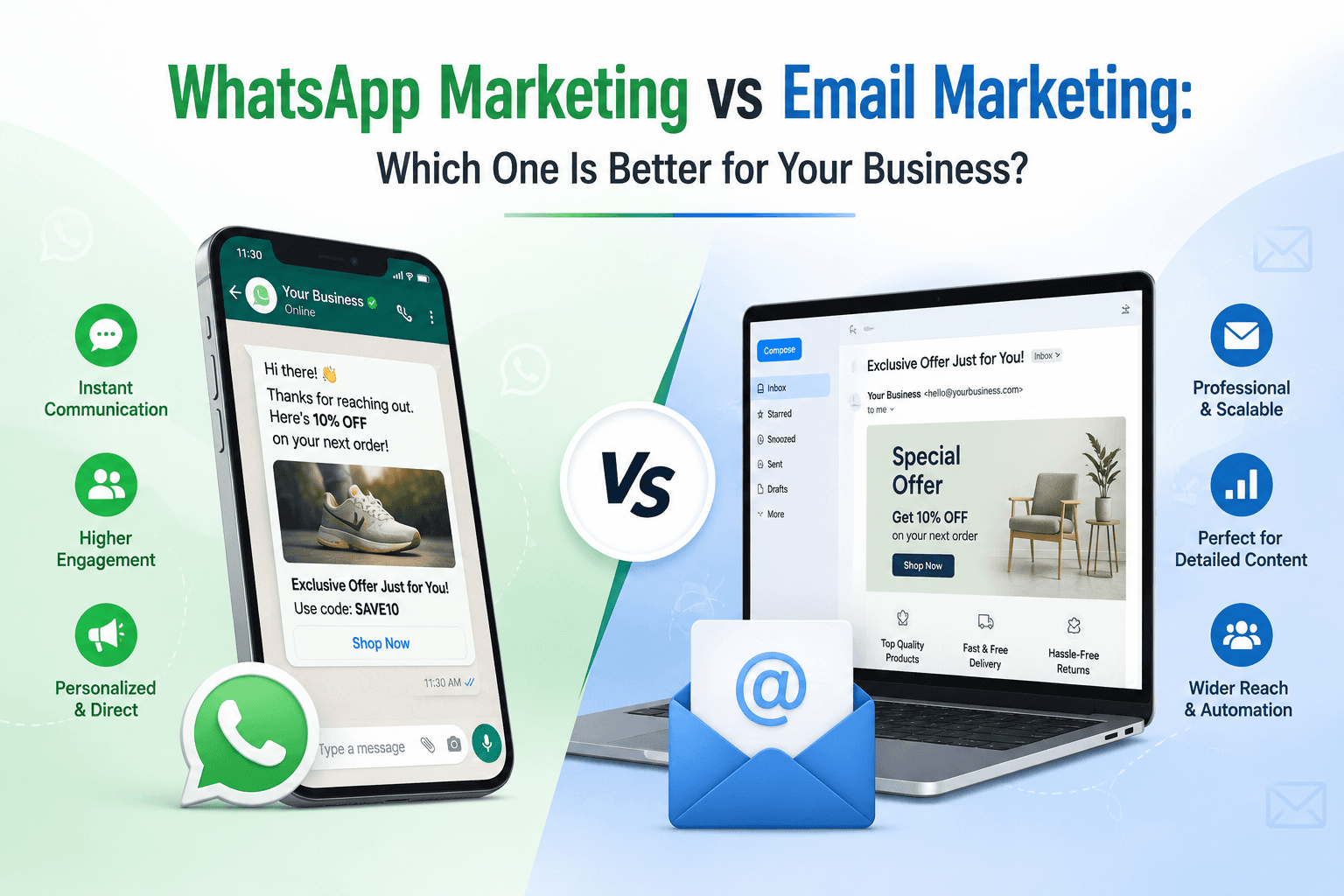
What Is the Biggest Difference Between WhatsApp Marketing and Email Marketing?
The biggest difference is how customers interact with your message.
WhatsApp is built for instant conversations.
Email is designed for detailed communication.
If you want customers to reply quickly, confirm appointments, place orders, or ask questions, WhatsApp usually creates a smoother experience.
If you want to send monthly newsletters, detailed product updates, or long educational content, email remains an excellent choice.
Which Channel Gets Better Open Rates?
For many businesses, WhatsApp messages are opened much faster than emails because people regularly check their messaging apps throughout the day.
Emails are still effective, but they often compete with hundreds of other messages inside a crowded inbox.
This doesn't mean email is outdated—it simply means each channel serves a different purpose.
Which One Generates More Customer Engagement?
When your goal is conversations, WhatsApp usually wins.
Customers can:
Ask questions instantly
Confirm bookings
Share their location
Upload documents
Complete purchases
Get support without switching platforms
This conversational experience helps businesses respond faster and build stronger customer relationships.
Should Businesses Choose WhatsApp or Email?
The best answer is neither.
Choose both.
Successful businesses don't replace email with WhatsApp—they use each channel where it performs best.
For example:
Use WhatsApp for:
Order confirmations
Delivery updates
Appointment reminders
Promotional offers
Customer support
Lead follow-ups
Payment reminders
Use Email for:
Monthly newsletters
Product announcements
Reports
Educational content
Long-form offers
Company updates
Together, they create a stronger customer communication strategy.
How Can Businesses Manage Multiple Communication Channels Easily?
Managing WhatsApp, Instagram, Messenger, SMS, and Email separately becomes difficult as your business grows.
An Omnichannel messaging platform allows your team to manage all customer conversations from one dashboard.
Instead of switching between multiple apps, your sales, marketing, and support teams can respond faster while keeping customer information organized.
Can AI Help Automate Customer Conversations?
Yes.
Modern businesses are using a Smart AI chatbot for business to answer common customer questions, qualify leads, send instant replies, and reduce support workload.
AI automation works around the clock, ensuring customers receive quick responses even outside business hours.
This improves customer satisfaction while saving valuable time for your team.
How Can Restaurants Use WhatsApp Marketing?
Restaurants receive hundreds of customer inquiries every week.
Instead of replying manually, many businesses now use a WhatsApp chatbot for restaurants to automate table reservations, menu sharing, order tracking, delivery updates, and customer support.
When combined with Restaurant Automation Software, restaurant owners can reduce response times and improve customer experience without increasing staff workload.
How Can Real Estate Businesses Generate More Leads?
Real estate agents often lose potential customers because follow-ups happen too late.
Using WhatsApp lead automation for real estate agents, businesses can instantly respond to new inquiries, schedule property visits, send brochures, answer common questions, and keep leads engaged throughout the buying journey.
Fast responses often lead to better conversion rates.
Can Financial Businesses Automate Customer Communication?
Yes.
A WhatsApp Finance Automation Platform helps financial businesses automate loan updates, payment reminders, document requests, customer verification, policy notifications, and account-related communication while maintaining a professional customer experience.
Automation reduces manual work and helps customers receive important information on time.
What Are WhatsApp RCS Services for Business?
Many businesses are expanding beyond traditional messaging by combining WhatsApp with rich messaging experiences.
WhatsApp RCS services for business can help brands deliver interactive customer communication that includes rich media, buttons, verified branding, and better engagement across supported messaging channels.
This creates a more modern communication experience for customers.
Can WhatsApp and Email Work Together?
Absolutely.
The highest-performing businesses rarely depend on a single communication channel.
A customer might:
Discover your business through social media.
Receive product information through email.
Ask questions on WhatsApp.
Complete a purchase.
Receive delivery updates on WhatsApp.
Get future offers through both channels.
Using both channels together creates a seamless customer journey.
Which Marketing Strategy Is Right for Small Businesses?
If your goal is:
Faster replies
More customer engagement
Better lead conversion
Personalized communication
Automated customer support
WhatsApp marketing is an excellent investment.
If your goal is:
Sharing detailed information
Building long-term relationships
Sending newsletters
Educational marketing
Email marketing remains an important part of your strategy.
For most businesses, combining both channels delivers the best results.
Frequently Asked Questions
Is WhatsApp marketing better than email marketing?
Neither is universally better. WhatsApp is ideal for real-time conversations and quick customer engagement, while email is better for detailed communication and long-form content. Most businesses benefit from using both.
Can small businesses use both WhatsApp and email marketing?
Yes. Even small businesses can use both channels to engage customers at different stages of the customer journey.
Which channel is better for customer support?
WhatsApp is generally more suitable because customers can ask questions and receive instant replies in a familiar chat interface.
Does WhatsApp marketing increase sales?
It can. Faster responses, personalized communication, and timely follow-ups often help businesses convert more leads into customers.
Can AI automate WhatsApp customer conversations?
Yes. AI-powered chatbots can answer common questions, qualify leads, book appointments, and provide customer support automatically.
What industries benefit the most from WhatsApp marketing?
Restaurants, retail, healthcare, education, finance, real estate, travel, automotive, and service businesses all use WhatsApp to improve customer communication and increase engagement.
Final Thoughts
Choosing between WhatsApp marketing and email marketing isn't about finding a winner—it's about understanding how each channel helps your customers.
WhatsApp is ideal for real-time conversations, faster support, and personalized engagement. Email remains a powerful channel for sharing detailed information and building long-term customer relationships.
Businesses that combine both channels with automation and AI can create a smoother customer experience, reduce manual work, and improve marketing results across every stage of the customer journey.