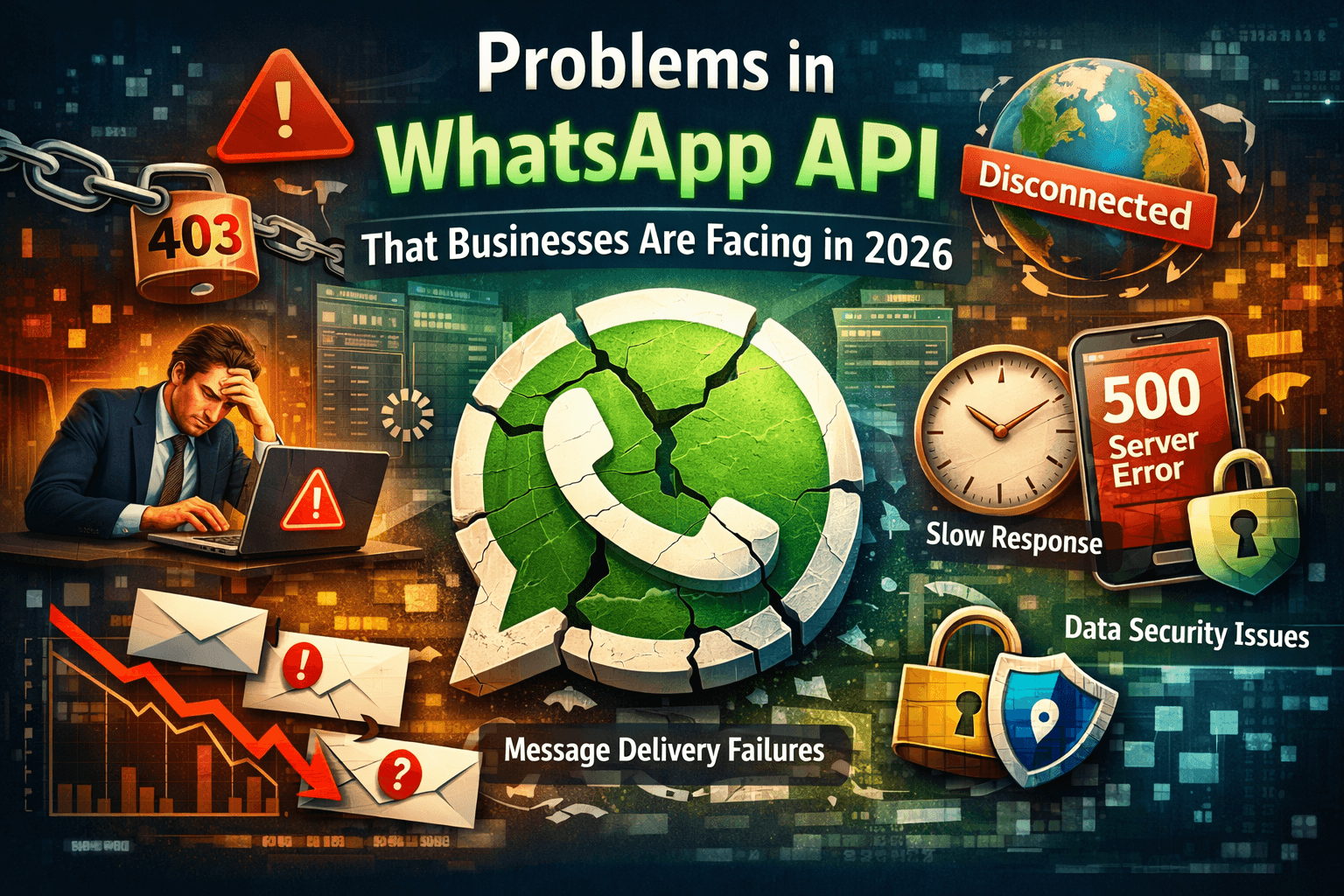
In 2026, more companies are building customer journeys on top of the WhatsApp Business API than ever before. From eCommerce and healthcare to education and banking, it has become a core communication channel.
But if you look at what business owners are actually searching on Google and YouTube, the story is different:
“Why are my WhatsApp templates getting rejected?”
“How to reduce WhatsApp API costs?”
“WhatsApp broadcast not delivering”
“How to get WhatsApp blue tick for business?”
“Best WhatsApp API provider in India?”
“How to track WhatsApp campaign performance?”
Behind these searches are real operational problems.
Let’s break down the biggest WhatsApp API challenges businesses are facing in 2026 — and practical ways to solve them without turning your system into a technical headache.
1. Why Is WhatsApp API Becoming Expensive for Growing Businesses?
One of the most searched queries today:
“WhatsApp Automation pricing for businesses”
With conversation-based pricing, charges increase as your inbound and outbound conversations grow. For businesses running campaigns, support automation, reminders, and follow-ups, costs can spiral quickly.
The Real Problems:
Unoptimized template usage
Sending unnecessary session messages
Poor segmentation
No visibility into conversation categories
Overuse of broadcast messages without targeting
What Smart Teams Are Doing:
Using automated drip campaigns with fallback messaging instead of blasting
Segmenting audiences based on behavior
Tracking campaign engagement before sending follow-ups
Monitoring conversation categories closely
Tools like WhatsApp Marketing Automation Platform solutions now help businesses manage flows efficiently rather than just sending bulk messages blindly.
2. Why Are WhatsApp Templates Getting Rejected So Often?
Search trend:
“WhatsApp template rejected reason”
Template approval under Meta policies is stricter in 2026. Promotional wording, vague offers, or missing variables can trigger rejection.
Common Issues:
Over-promotional language
No clear user context
Misleading financial or healthcare claims
Too many emojis or urgency words
How Businesses Are Fixing It:
Writing context-driven templates
Creating category-specific templates (utility vs marketing)
Running pre-check validations before submission
Keeping templates aligned with real customer intent
Instead of writing generic blasts, businesses now build customer journeys using AI powered chatbots for businesses that trigger messages based on actual actions.
3. Why Is WhatsApp Broadcast Not Delivering Properly?
Search query:
“WhatsApp broadcast messages not delivered”
Many companies invest in WhatsApp broadcast messaging expecting 100% delivery — but quality rating, user engagement, and block rates now impact reach heavily.
The 2026 Reality:
High block rate lowers quality score
Repetitive campaigns reduce engagement
Irrelevant messages affect sender reputation
What Works Better:
Behavioral targeting instead of mass broadcasting
Click tracking for WhatsApp marketing
Personalized follow-ups based on interaction
Clear opt-in management
Businesses shifting from simple WhatsApp Broadcast Messages to intelligent campaign tracking are seeing higher retention.
4. How Can Businesses Track ROI from WhatsApp Campaigns?
Another trending search:
“whatsapp campaign tracking”
In earlier years, WhatsApp felt like a black box. Now, businesses demand clarity.
What Companies Want:
Click tracking
Funnel visibility
Conversion tracking
Integration with CDP software
Cross-channel attribution
Without proper tracking, marketing spend feels blind.
The smarter approach is connecting WhatsApp with a customer data platform software layer so every click, reply, and purchase is measurable.
5. Why Is Managing Multiple Channels Becoming a Nightmare?
Search trend:
“WhatsApp Instagram Facebook unified inbox”
Customers don’t stick to one platform. They message on:
WhatsApp
Instagram
Facebook Messenger
Website chat
Email
Handling all of this separately causes:
Delayed replies
Duplicate conversations
Missed leads
Frustrated customers
In 2026, businesses are actively searching for an Omnichannel messaging platform or multi-channel live chat inbox to unify conversations.
Centralized dashboards are no longer a luxury — they’re operational necessity.
6. Why Is Getting the WhatsApp Blue Tick Still Confusing?
Search volume remains high for:
“WhatsApp blue tick for business”
“meta verified for WhatsApp business”
“Get WhatsApp business blue tick”
The verification process can feel unclear:
Documentation mismatch
Brand inconsistency
Incomplete business profile
No media presence
Companies that treat verification as part of brand positioning (not just a badge) tend to get approved faster.
7. Why Do SaaS, Real Estate, Healthcare & Education Face Unique API Challenges?
Different industries search for very specific solutions:
WhatsApp API for E-commerce → cart recovery, order updates
Healthcare WhatsApp automation → secure patient communication, automated reminders to patients
WhatsApp lead automation for real estate agents → property follow-ups
WhatsApp API for Education → admission open message for school, automated class reminders
Each vertical has compliance, timing, and personalization challenges.
Generic setups fail because industry workflows differ dramatically.
8. Is WhatsApp Automation Replacing Human Support — or Breaking It?
Another rising concern in 2026:
“Customers hate bots. How do we balance automation and human support?”
Bad automation leads to:
Infinite loops
No escape to human agent
Frustration
Increased drop-offs
The smarter strategy:
Smart AI chatbot for business for first-level queries
Easy human takeover
Context preserved between bot and agent
Intelligent routing
Automation should reduce friction, not create it.
So Where Does a Brand Like Chati Fit In?
Instead of positioning itself as “just another WhatsApp Business API provider,” Chati approaches the problem differently.
Businesses in 2026 don’t just need:
WhatsApp access
They need:Cost optimization
Better onboarding
Campaign intelligence
Unified inbox management
Automation that doesn’t feel robotic
Chati focuses on solving the operational gaps businesses are actively searching about — whether it’s WhatsApp onboarding automation for SaaS, smarter broadcast controls, click tracking, or building structured customer journeys.
Not by replacing human interaction — but by making it more organized, measurable, and scalable.
Final Thoughts: The Real WhatsApp API Problem Isn’t the API
The biggest issue in 2026 isn’t the WhatsApp Business API itself.
It’s:
Poor implementation
Lack of strategy
Over-automation
Under-tracking
Disconnected systems
Businesses that treat WhatsApp as a structured communication platform — not just a bulk messaging tool — are the ones scaling efficiently.
And that’s exactly where the conversation is shifting this year.
If you're building on WhatsApp in 2026, the real question is not:
“Should we use it?”
But:
“Are we using it intelligently enough to grow?”