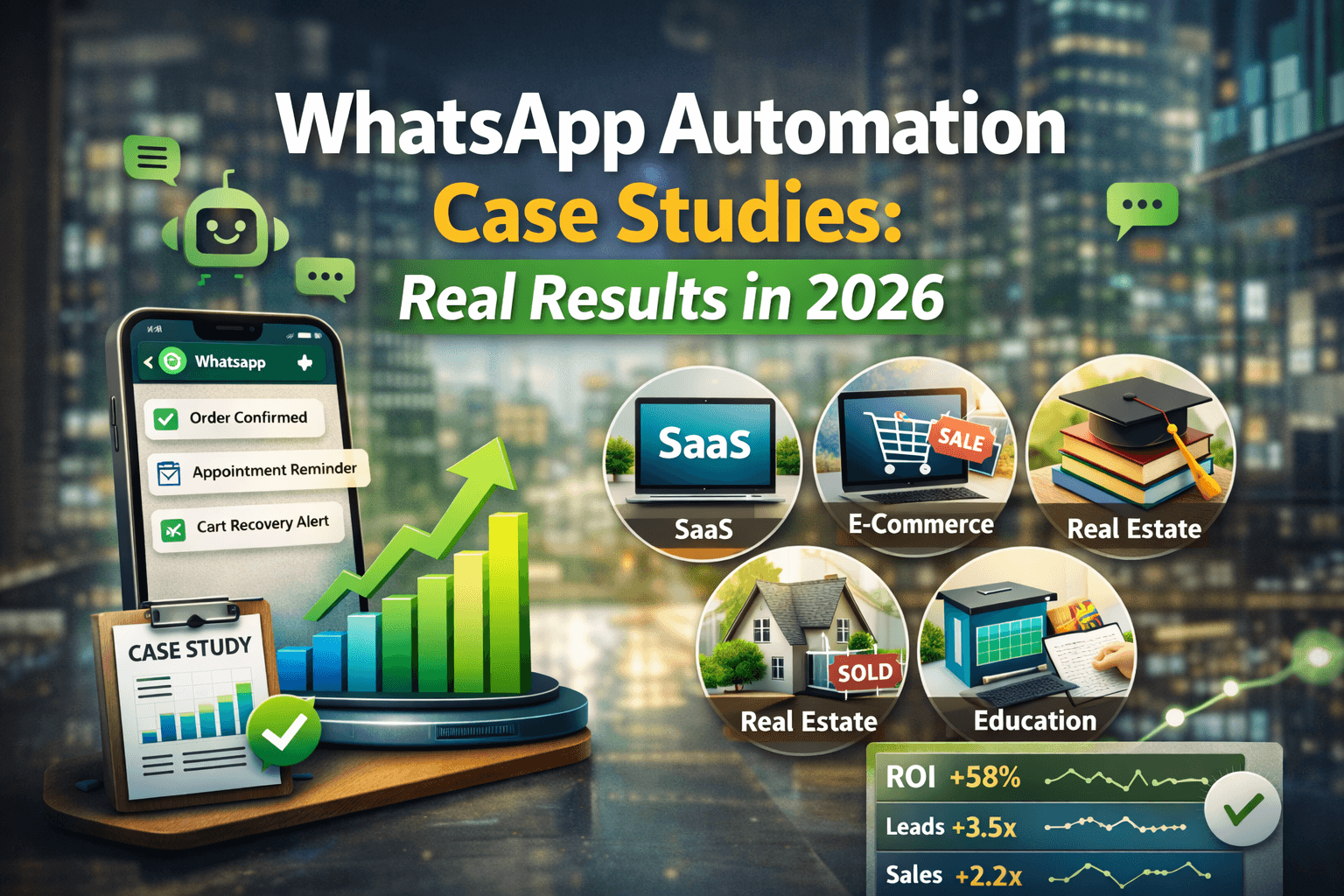
In 2026, WhatsApp has become one of the most powerful business communication channels. From startups to enterprises, companies are using automation to reduce response time, improve conversions, and scale customer support.
In this guide, we’ll look at real case studies and measurable results from different industries and show how businesses are using WhatsApp automation to grow.
What Is WhatsApp Automation?
WhatsApp automation is the use of software, APIs, and workflows to send, receive, and manage messages automatically. It includes:
Automated replies
Chatbots
Drip campaigns
Order and payment notifications
Appointment reminders
Lead qualification flows
When done right, automation saves time while improving customer experience.
Case Study 1: SaaS Company Using WhatsApp Automation for SaaS Onboarding
Industry: B2B SaaS
Team Size: 18 employees
Challenge
A SaaS startup was struggling with:
Low trial-to-paid conversion
High drop-offs during onboarding
Repetitive support queries
Users signed up but failed to complete setup.
Solution
The company implemented WhatsApp Automation for SaaS onboarding using:
Welcome messages
Step-by-step setup tutorials
Automated feature explanations
Human handoff for complex issues
They also added AI powered chatbots for businesses to answer common technical questions.
Results (After 3 Months)
✅ 41% increase in trial activation
✅ 27% higher paid conversions
✅ 52% reduction in support tickets
Key Lesson
Guided onboarding on WhatsApp builds trust faster than email or in-app messages.
Case Study 2: E-commerce Brand That Boosted Sales Using WhatsApp
Industry: D2C E-commerce
Monthly Orders: 9,000+
Challenge
The brand faced:
High abandoned cart rate
Low repeat purchases
Poor engagement with email campaigns
Solution
They launched automated campaigns to Boost E-commerce Sales with WhatsApp, including:
Abandoned cart reminders
Order confirmations
Delivery tracking
Product recommendations
Post-purchase feedback flows
They also integrated their store with WhatsApp API.
Results (After 90 Days)
✅ 34% recovery of abandoned carts
✅ 22% increase in repeat orders
✅ 18% growth in average order value
Key Lesson
WhatsApp works better than email for transactional and promotional messages in e-commerce.
Case Study 3: Real Estate Agency Using WhatsApp Automation
Industry: Real Estate
Locations: 3 Cities
Challenge
A mid-sized real estate firm was losing leads due to:
Slow response time
Manual follow-ups
Poor lead tracking
Solution
They implemented WhatsApp for Real Estate automation:
Instant lead responses
Property brochures via chat
Automated site visit scheduling
Follow-up reminders
CRM integration
Chatbots qualified leads before assigning them to agents.
Results (After 6 Months)
✅ Response time reduced from 2 hours to 3 minutes
✅ 48% more qualified leads
✅ 31% increase in property visits
Key Lesson
Speed matters in real estate. Automated replies prevent lead leakage.
Case Study 4: EdTech Platform Using AI Chatbots
Industry: Online Education
Students: 50,000+
Challenge
The platform struggled with:
High volume of admission queries
Repetitive course-related questions
Limited support staff
Solution
They deployed AI powered chatbots for businesses on WhatsApp to handle:
Admission information
Course schedules
Fee details
Demo class bookings
Automated reminders
Bots were trained using past chat data.
Results (After 4 Months)
✅ 65% of queries resolved automatically
✅ 40% reduction in support cost
✅ 29% increase in enrollments
Key Lesson
AI chatbots can scale student support without increasing manpower.
Common Patterns Across All Case Studies
After analyzing multiple industries, we found these common success factors:
1. Fast First Response
Businesses replying within 5 minutes saw higher conversions.
2. Personalization
Using customer names, order history, and preferences improved engagement.
3. Hybrid Support
Combining automation with human agents delivered the best results.
4. Consistent Follow-Ups
Automated reminders reduced drop-offs and missed opportunities.
How to Implement WhatsApp Automation for Your Business
Follow this simple framework:
Step 1: Define Your Goal
Decide whether you want to improve:
Sales
Support
Onboarding
Retention
Step 2: Choose the Right Use Case
Examples:
Abandoned carts
Appointment reminders
Lead qualification
Technical support
Step 3: Build Automation Flows
Create workflows for:
Welcome messages
FAQs
Escalation rules
Follow-ups
Step 4: Integrate Your Tools
Connect WhatsApp with:
CRM
E-commerce platform
Helpdesk
Analytics tools
Step 5: Measure and Improve
Track:
Response time
Conversion rate
Engagement
Customer satisfaction
Optimize regularly.
Mistakes to Avoid in WhatsApp Automation
Many businesses fail due to these errors:
❌ Sending too many promotional messages
❌ No option to talk to a human
❌ Poor chatbot training
❌ Ignoring analytics
❌ Over-automation
Automation should help customers, not frustrate them.
Frequently Asked Questions
Is WhatsApp automation suitable for small businesses?
Yes. Even small teams can automate greetings, FAQs, and reminders.
How long does it take to see results?
Most businesses see improvements within 30–90 days.
Do I need technical skills?
No. Most platforms offer no-code builders.
Is automation compliant with WhatsApp policies?
Yes, when you use official APIs and get user consent.
Final Thoughts
These real-world examples show that WhatsApp automation is no longer optional—it’s a growth tool.
Whether you are running a SaaS company, e-commerce store, real estate agency, or education platform, structured automation can deliver measurable ROI.
Start small, test continuously, and scale what works.
If implemented correctly, WhatsApp can become your highest-performing customer engagement channel in 2026 and beyond.